
Kenwood Two Way Radios
Start with the calls and locations your team needs, then check the exact Kenwood model and operating mode. Kenwood’s UK range includes licence-free PMR446 handhelds and radios for authorised systems; a shared brand name does not make them interchangeable. Browse the models, then use the family comparison, fleet checks and complete-quote checklist below.
Page 2 of 2 · 16 items
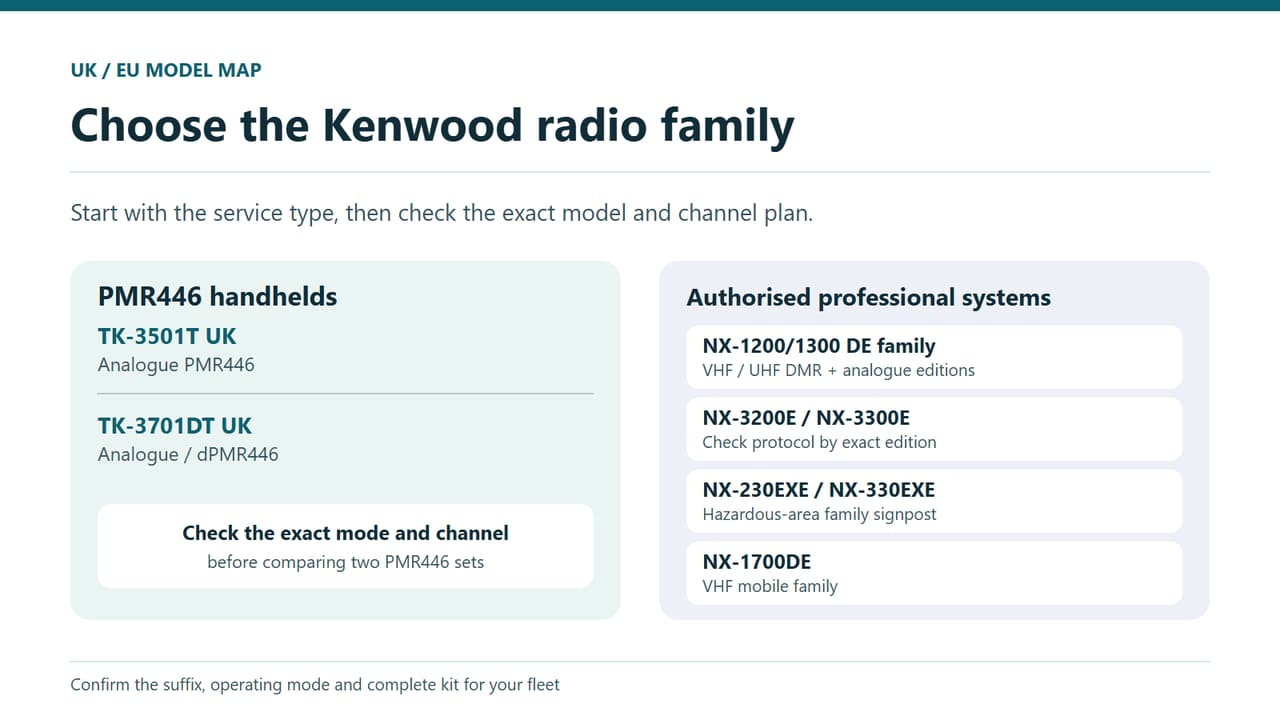
Which Kenwood radio family fits the job?
Decide first whether qualifying licence-free PMR446 handheld use can cover the actual routes, or whether the proposed professional system needs an Ofcom Business Radio authorisation. Ofcom’s current PMR446 interface requirement limits the exemption to hand-portable, integral-antenna, direct-use equipment within its technical conditions; it excludes base stations and repeaters. A Kenwood name or a low-power setting does not establish that a different radio qualifies. The Business Radio guidance explains the separate licence routes and technical conditions for other systems.
| Starting point | What the manufacturer identifies | Buyer check |
|---|---|---|
| TK-3501T | Kenwood UK identifies TK-3501T as an analogue FM PMR446 handheld for UK use. | Confirm that the exact offered model is the UK T variant and check its channel and tone setup against radios you already use. |
| TK-3701DT | Kenwood UK identifies TK-3701DT as a handheld with analogue PMR446 and digital dPMR446 modes. | Check the UK DT identity and the actual mode, channel and code used by each group. Digital mode does not by itself make it talk to an analogue or different digital fleet. |
| NX-1200/1300 DE family | Kenwood’s UK catalogue lists VHF NX-1200DE2/DE3 and UHF NX-1300DE/DE2/DE3 DMR/analogue portables, with different keypad arrangements named for the UHF editions. | Read the full suffix on the label. Check the operating band, controls, programmed mode and the relevant licence before treating a catalogue family as your delivered radio. |
| NX-3200/3300 family | The Kenwood UK digital catalogue lists NX-3200E VHF and NX-3300E UHF NEXEDGE/DMR/analogue portables. Kenwood’s NX-3000 family guide assigns these models the 14-pin universal connector; its original versions sheet shows full-keypad, standard-keypad and basic control choices. | Check the exact E/E2/E3 control edition, permitted band and mode, accessory connector and programmed system. No multi-protocol label alone establishes fleet fit. |
| NX-3220/3320 family | The UK digital catalogue lists NX-3220E VHF and NX-3320E UHF with E full-keypad, E2 standard-keypad and E3 basic choices. Kenwood’s family guide identifies their 2-pin connector. The specific NX-3220E page says its DMR Tier III mode needs a separate KWD-3302TR licence. | Confirm the full model and suffix, enabled modes, allowed audio lead and system configuration; the 2-pin and 14-pin accessory routes are distinct. The NX-3220E entitlement example is not a promise for another edition. |
| NX-1700DE mobile | Kenwood identifies NX-1700DE as a VHF DMR/analogue mobile transceiver for EU use. | Plan the antenna, power, mounting and licence as a complete vehicle or fixed-position system. A mobile radio is not itself a repeater or a supplied installation. |
| NX-230EXE / NX-330EXE | The UK catalogue places these VHF/UHF NEXEDGE models in its ATEX/IECEx family; the NX-230EXE support page links exact safety manuals and certification documents. | Use the actual marking, current safety manual, approved battery/accessory combination and site classification. The family listing does not approve a radio for a particular gas, dust, zone or temperature condition. |
These are manufacturer family starting points, not a statement that every named edition, charger, accessory or package is on sale here. For the underlying rules, use the UK PMR446 guide, analogue and digital compatibility guide and hazardous-area radio guide.
Will a proposed Kenwood radio join your existing fleet?
Write down the labels and operating setup of the radios you intend to keep. Compare the actual VHF or UHF hardware band, permitted frequency/channel plan, analogue or digital mode, digital protocol, signalling and system features. Then check whether the proposed unit is programmed and authorised to use that arrangement. Two Kenwood radios can belong to different families; two PMR446 radios can also use different analogue and digital modes. A shared connector shape or a “multi-protocol” catalogue description does not settle those checks.
Controls and connectors matter as well as RF compatibility. Kenwood’s catalogue distinguishes NX-1200/1300 control editions and the NX-3220/3320 E/E2/E3 choices; its NX-3000 family guide separates the 2-pin NX-3220/3320 from the 14-pin NX-3200/3300. Ask users to try the actual model’s channel and group controls with the gloves or audio equipment they will wear, then match the complete accessory chain. Check any emergency function separately against the programmed system. Record the exact model and suffix, rather than quoting only “NX-1300” or “Kenwood digital”. If the existing fleet has a programmed system, have the responsible licensee or system maintainer confirm the change before relying on it.
For a mobile installation, read the vehicle radio setup guide as a planning aid; the vehicle, radio, antenna and licence details need their own review. For a previously used set, the used Kenwood selection page has a separate condition and evidence job. A used unit’s label, programming, battery and charger need the same exact checks.
Check the complete radio, power and accessory quote
Ask the seller to name every proposed part, including anything listed as optional or separately supplied. A manufacturer’s standard-accessory list describes its own model presentation; it does not prove what a particular retailer bundle contains. The charger and mains guide explains why a cradle, battery, power supply and radio must be checked as a combination.
- Radio and use: exact model, suffix, VHF/UHF band, regional version, intended channels/modes, relevant licence or PMR446 conditions, and any optional software entitlement.
- Power: the actual battery part, charger cradle, power supply and plug arrangement; quantities and whether spares or multi-unit charging are included.
- Audio and carrying: exact radio connector, earpiece or microphone controller chain, carrying method and wearing arrangement. Test the complete combination rather than assuming one accessory fits every Kenwood family.
- Handover: configuration record, user controls, site trial, training and support route. Note what remains to be confirmed before anyone depends on the setup.
For hazardous-area work, the approved accessory combination and site assessment come before an order; do not substitute a physically fitting battery, antenna or headset. For ordinary site coverage, compare calls on the routes that matter using the actual proposed system, rather than treating the model family or a maximum-range number as an acceptance result.