
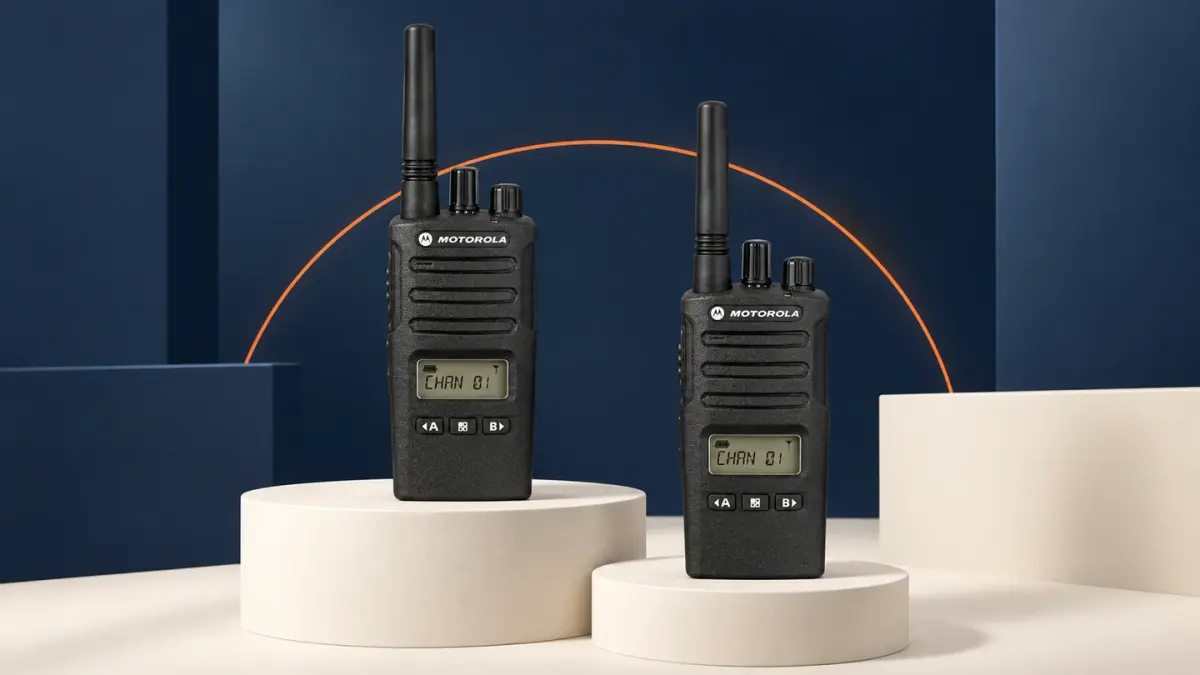
Walkie Talkies & PMR446: The UK Licence-Free Guide
Walkie talkies are the easy way into two way radio. Compliant PMR446 handsets need no individual Ofcom licence or airtime subscription, which makes them the natural choice for shops, hospitality, small sites and days out. Here is how they work in the UK and how to pick a good set.
What licence-free means in the UK
UK walkie talkies run on PMR446, a band of public radio channels anyone can use without an Ofcom licence. To stay licence-free a radio must keep to the rules: a maximum of 0.5 watts, a fixed antenna that cannot be removed, and type approval for PMR446. Every proper walkie talkie meets these, so there is nothing to apply for and nothing to pay.
How far do they really reach?
Be realistic. PMR446 is line-of-sight, so expect a few hundred metres around buildings and up to a couple of kilometres across open ground. Walls, steel and hills cut that down. On a single floor, a shop, a school or a small site, it is usually more than enough.
Analogue or digital PMR446?
Analogue PMR446 gives you 16 channels and pairs with almost anything else on the band. Digital dPMR446 adds up to 32 channels with clearer audio, longer battery life and features like text messaging, which helps when several teams share the air at a busy event.
When to step up to a licensed radio
If you keep running out of range, fighting interference on busy channels, or need radios across a large or multi-storey site, it is time to look at licensed two way radios. They cost more and need an Ofcom licence, but they offer more system options, subject to a coverage test and the licence conditions.
Can I use walkie talkies for my business?
Absolutely. Plenty of UK shops, cafes, sites and events run perfectly well on licence-free walkie talkies. We can put together a ready-to-go set with chargers and earpieces to match how you work.
Licence-free is the natural starting point for schools, churches and smaller care homes — each guide lists the exact models, prices and typical kit.
Licensing reference: Ofcom business radio licence guidance. Fees and conditions checked 8 October 2026; confirm the current terms with Ofcom before transmitting.
Planning your equipment? Send your site details, quantities and existing radio models through our quote enquiry form. We can confirm the proposed setup, compatibility and availability before you decide.