
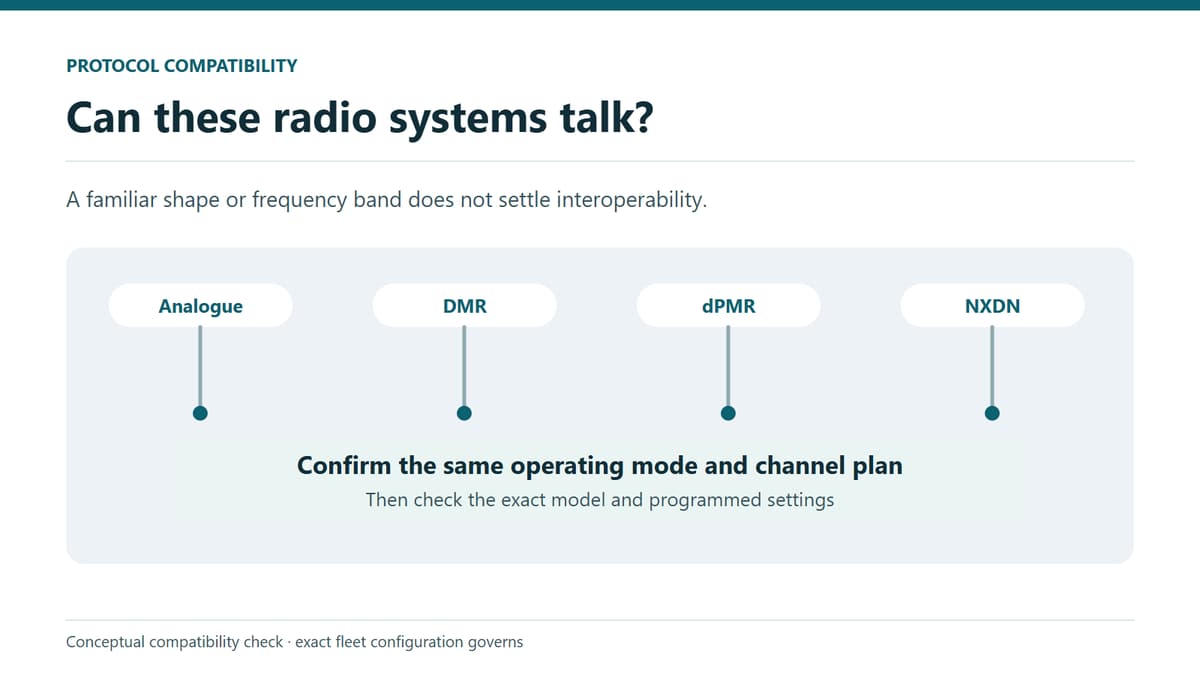
Can analogue, DMR, dPMR and NXDN radios work together?
Two radios do not become compatible because they share a brand, band or frequency. For a direct call, both must support the same operating mode and a matching, authorised channel plan. Analogue FM, DMR, dPMR and NXDN use different air interfaces. A radio sold as “multi-protocol” may offer more than one mode, but the exact variant, enabled options and programming still decide what it can use.
First identify the actual system
| System or term | What it means for matching a fleet |
|---|---|
| Analogue FM | Both ends need a compatible analogue channel configuration. A digital-capable radio can join an analogue fleet only when its exact model supports and is set to the required analogue mode; a digital transmission itself is not an analogue voice call. |
| DMR | A separate digital air interface. Tier I covers low-power digital PMR446 equipment with its own restrictions. Professional Tier II is conventional operation; Tier III is trunked system operation. Two-slot TDMA uses a 12.5 kHz carrier in Tier II/III. Check the tier, direct/repeater/trunked mode and system settings, not just the DMR logo. |
| dPMR | For licensed land-mobile dPMR under ETSI TS 102 658, 6.25 kHz FDMA Mode 1 is direct, Mode 2 includes base stations for repeat or gateways, and Mode 3 is managed access. Separate dPMR446 equipment under ETSI TS 102 490 is hand-portable peer-to-peer equipment with its own scope. Neither the common dPMR name nor narrow FDMA spacing makes it interchangeable over the air with NXDN. |
| NXDN | A distinct FDMA air interface with 6.25 or 12.5 kHz channel-spacing options and conventional and trunked systems. Match the exact width and system mode. NEXEDGE is KENWOOD's trade name for systems using NXDN; the NEXEDGE family label alone does not establish the air interface of every exact model. |
| TETRA and P25 | Other digital radio standards, not alternative names for DMR, dPMR or NXDN. Their network, direct-mode, band and provisioning needs require their own system check; a shared frequency range does not create direct voice compatibility. |
ETSI's dPMR air-interface specification, the DMR Association's tier summary and the NXDN Forum's technical summary describe those distinctions. Icom explicitly confirms that NXDN and dPMR do not interoperate over the air.
The dPMR446 peer-to-peer specification and Ofcom's PMR446 guidance are distinct from a licensed dPMR system design. PMR446 equipment is licence-exempt only if its construction and operation meet the exemption conditions. Sharing the PMR446 band does not make analogue FM, DMR Tier I, dPMR446 or their programmed groups mutually understandable; check the exact digital mode and channel setup.
In conventional operation, a user selects a programmed channel for a direct call or repeater. A trunked system allocates traffic channels through its infrastructure, so a compatible radio still needs the network's provisioning and authority. These are different system designs within some protocol families, not settings that every handset can switch between.
What must match beyond the frequency?
Record the authorised transmit and receive frequencies, band and channel spacing; analogue or exact digital protocol; direct, repeater or trunked operation; and the programmed group or individual calling settings. On DMR, a colour code distinguishes activity on a channel, a time slot selects a TDMA path where that mode uses two slots, and a talkgroup addresses a group call. Confirm the repeater or direct-mode arrangement and all relevant settings with the fleet administrator. A matching colour code is only one part of this configuration. The ETSI DMR voice specification defines these air-interface fields. Encryption, if used, requires compatible settings and authorised key material; a matching label or number alone does not prove working secure communications.
DMR's common air interface helps interoperability, but it does not promise that every optional feature works across manufacturers. The DMR Association's interoperability process distinguishes mandatory and optional tested features and says its certificates are specific to hardware platform and software release. For a replacement handset, verify the exact certificate or manufacturer documentation, firmware and feature entitlements, and test the required voice, emergency, data and roaming behaviour with the actual system before a fleet rollout.
Mixed-mode migration is a configured capability
Some radios and repeaters can detect or select analogue and digital operation, which can help a staged move from an analogue fleet. It does not turn an analogue-only handset into a digital handset or make different digital protocols the same. KENWOOD's NX-3000 brochure documents selected NXDN, DMR and FM analogue choices in that family, while its NX-1200/1300 specification distinguishes N (NXDN), D (DMR) and A (analogue) suffixes. Verify the exact regional SKU and purchased/activated options: a family brochure is not proof that a particular unit has every mode enabled.
For migration, list existing analogue channels and users, identify a model and repeater that actually support the planned mixed mode, programme an agreed channel plan, and trial calls in both directions. Some forms of mixed mode let users share a channel during migration, but one call's operating mode still has to be received by the other end. Preserve any site licence, coverage and emergency-call obligations while the change is tested.
When a gateway is needed
If one group must remain on DMR and another on NXDN, dPMR, TETRA or an IP push-to-talk service, simply matching channel numbers or installing multi-protocol radios is not a system-wide bridge. A designed interface or gateway may connect two systems, subject to both vendors' supported interfaces, network access, audio routing, call identity, emergency behaviour and security policy. Specify which calls and features must cross the boundary, then have the system operators validate the exact design. Do not assume a gateway carries every data or emergency feature just because ordinary voice passes.
Give a supplier a usable compatibility record
- List the current radio and repeater make, exact model suffix, regional band, firmware and any enabled software options.
- Provide the authorised channel plan and operating mode, including DMR colour code, slot and talkgroups or the equivalent settings for the actual protocol, through a secure approved route.
- State whether the job is direct radio-to-radio, an existing repeater, trunked network access or a gateway between systems.
- Name the functions that matter: group and private voice, emergency call, encryption, text/data, location, roaming and dispatch. Check each separately.
- Request a written, model-and-release-specific interoperability claim and a small on-system acceptance test before a wider purchase.
For the separate question of whether a particular frequency or channel use is authorised in the UK, see our UK radio licensing guide. For cryptographic confidentiality rather than call filtering, read our privacy codes and encryption guide.