
Two-way radio privacy codes and encryption: what protects a conversation?
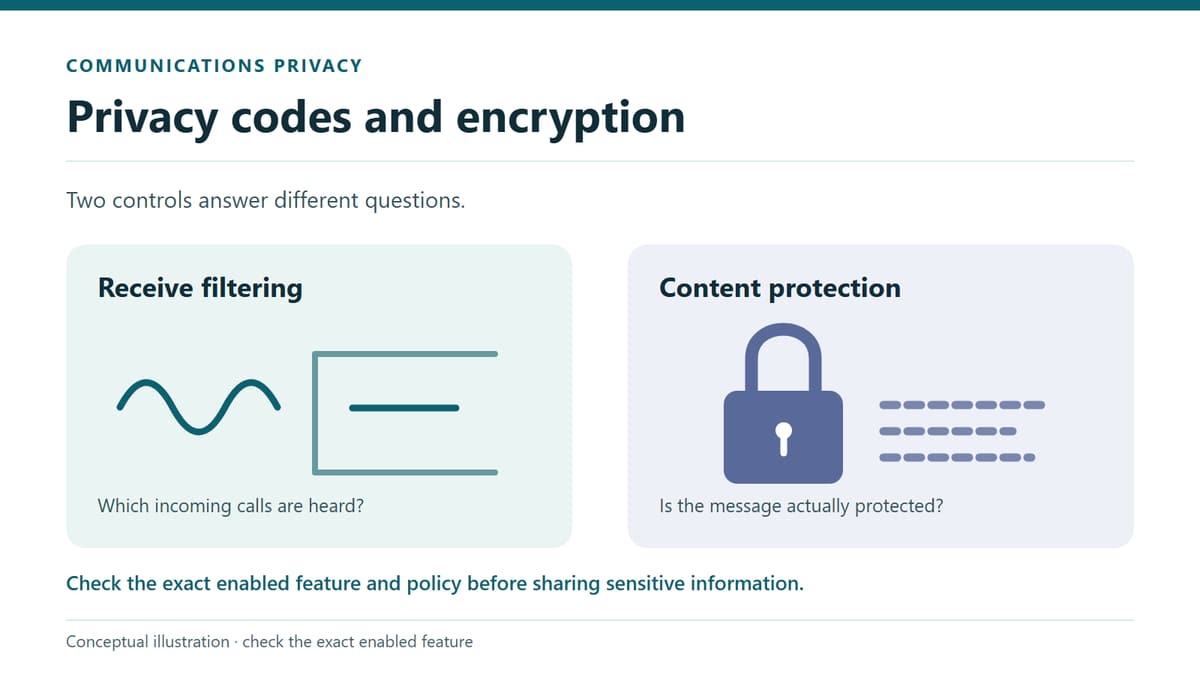
A “privacy code” on a two-way radio usually means receive filtering, not a private conversation. CTCSS tones and DCS codes can keep your speaker quiet when other users share a channel, but they do not encrypt what your group transmits. For genuinely sensitive information, ask what protection is actually enabled across the complete system before using the radio.
Three different controls
| Term | What it does | What it does not establish |
|---|---|---|
| CTCSS tone or DCS code | Controls when a receiver unmutes on a shared analogue channel. | Secrecy. Another suitably configured receiver may still hear the transmission. |
| Digital channel or talkgroup setting | Helps compatible radios select the intended digital call or group. | Encryption. “Digital” and “private call” are not proof that content is protected. |
| Encryption | Uses a cryptographic key to protect supported voice or data so correctly configured receiving equipment can recover it. | Automatic protection on every radio, channel, gateway or recording path. The exact enabled feature, keys and system boundaries matter. |
Ofcom describes CTCSS and DCS as ways to mute unwanted co-channel traffic. Its PMR446 guidance says the band is shared and users have no protection from radio interference. That spectrum rule is separate from confidentiality: a business-radio licence authorises specified radio use; it does not encrypt a conversation.
What counts as an evidenced encryption claim?
Ask for the exact model, regional edition and firmware, the supported encryption feature, whether it is enabled on the channels being used, and whether every intended radio and system component can use the same setting and keys. Confirm whether the protection covers voice, data or both; check any repeater, dispatch console, gateway, recording system and fallback mode. A feature in a brochure is a capability, not evidence that your delivered fleet has been configured to use it.
As a model-specific example, a Hytera PD782 regional user manual describes an encryption feature with separate enable and key-selection steps. Communicating radios need a compatible encryption configuration and key material; matching a displayed key ID alone is not an interoperability test. The manual does not prove the feature is enabled on a UK-delivered radio, another Hytera model, or an equipment mix from different brands. Ask for the actual configured fleet record and an agreed end-to-end acceptance test before calling a system secure.
What should stay off an open channel?
Until the organisation has approved the system and its information-handling rules, avoid speaking names with medical, safeguarding, financial or other sensitive details over an open or merely tone-filtered channel. Use the organisation's approved secure route for that information. Set clear call signs and message discipline, and train users to recognise when a conversation must move off radio.
The UK Information Commissioner says personal information needs security measures appropriate to the risk. UK GDPR does not require every item to be encrypted, but the ICO recommends encryption when personal information is transmitted electronically. Radio choice and operating practice should follow the organisation's own risk assessment and policy. A privacy tone alone does not meet a confidentiality requirement.
Before selecting equipment
- Decide whether the job is simply to reduce unwanted audio, or to protect content from interception.
- Write down the exact information you may transmit and the level of protection your policy requires.
- Check the licence or licence-exempt conditions separately from the confidentiality requirement.
- For encryption, confirm exact-model support, enabled options, key control and all endpoints; test the intended mixed fleet and fallback behaviour before operational use.
- Keep a non-sensitive alternative message procedure for lost keys, failed gateways or unavailable protected channels.
For spectrum choices, read our UK radio licensing guide and PMR446 guide. For the source distinctions above, see Ofcom's explanation of signalling codes, the Hytera PD782 manual and ICO encryption guidance.