
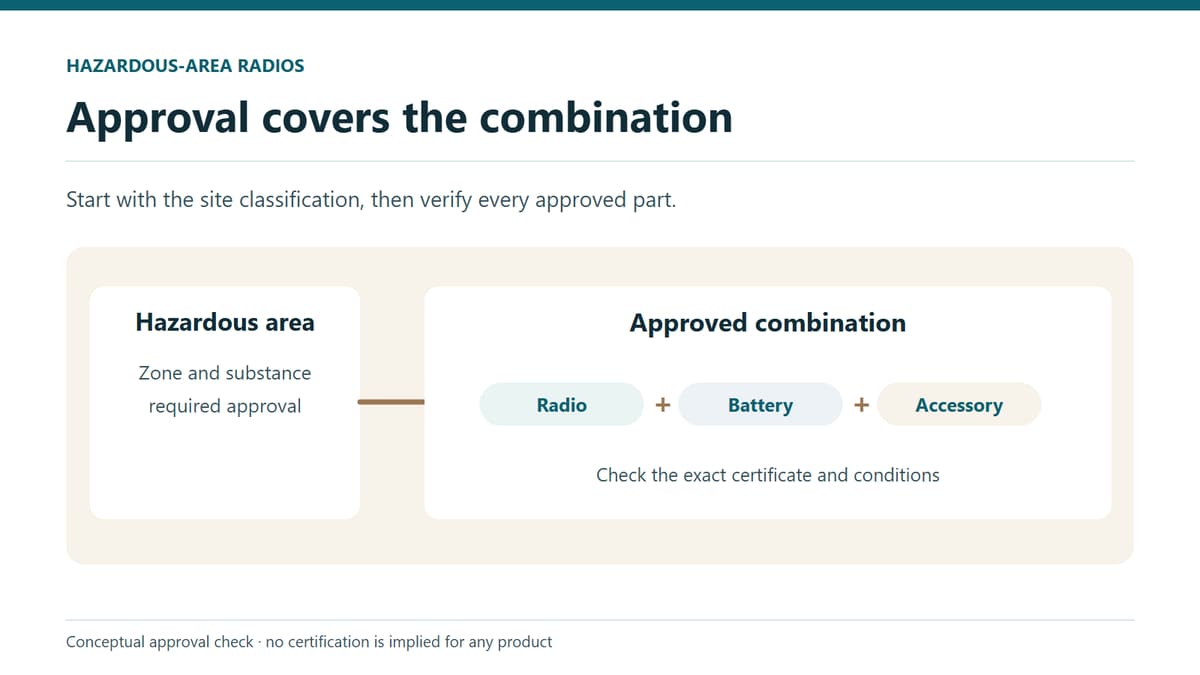
ATEX two-way radios: match the site zone and complete approved kit
An “ATEX radio” is not a safe shortcut for every hazardous site. The workplace's classified area and the equipment's full marking must match, and the battery, antenna and accessories used with the radio must be within that model's approved combination. Start with the site assessment; do not choose a handset from a generic “intrinsically safe” label alone.
ATEX describes the equipment and workplace framework for potentially explosive atmospheres. Intrinsic safety is one electrical protection method within that wider field, identified by “i” in the relevant marking; it is not a synonym for every ATEX product. HSE's protection-method list also names flameproof, pressurised and increased-safety methods. The exact Ex marking and certificate conditions, not the headline term, determine what can be considered for a classified area.
Start with the area, then the equipment
| Information to obtain | Why the exact detail matters |
|---|---|
| Classified area | The employer's DSEAR assessment identifies the zone, its boundaries and whether the hazard is gas, vapour, mist or dust. A supplier cannot infer the zone from an industry name alone. |
| Required equipment marking | Compare the radio's Ex marking, equipment group/category, gas or dust group, temperature class or maximum surface temperature, ambient limits and certificate conditions with the site specification. |
| Complete carried system | Check the exact radio variant, approved battery, antenna, speaker microphone, earpiece, adaptor and carrying arrangement against the model's regional safety instructions. A physically fitting accessory is not automatically approved. |
| Charging and maintenance | Use the manufacturer's approved charger and follow the exact safety leaflet for battery changes, charging, inspection and repair. Plan where these actions will occur outside the classified area when required. |
HSE says employers must classify places where explosive atmospheres may occur and select equipment appropriate for those zones. In Great Britain, equipment intended for potentially explosive atmospheres must meet the applicable product rules, with suitable Ex/conformity marking, a declaration and English instructions. Northern Ireland has a separate product-law route; check the applicable regime for the site. The site's competent safety lead should confirm suitability before use.
Why the exact variant and accessories matter
Motorola's current R7Ex UHF declaration identifies particular full-keypad and no-keypad radio variants, includes an accessory part-number addendum, and points to safety manual MN010389A01 for the combined Ex rating. The declaration is a useful identity check; use that current regional safety manual for the complete approved combination and its handling conditions. Hytera's HP795Ex IIC page likewise lists particular Ex batteries and charging and audio parts. Neither example certifies a different radio, battery or third-party accessory.
Do not treat an ingress rating such as IP68, a rugged case, or an “Ex” word in a listing title as proof of suitability for your zone. The exact marking and certificate conditions govern. If a radio or approved part is damaged, altered or missing its readable marking, take it out of hazardous-area service under the site's procedure and arrange competent inspection.
What to include in a quotation request
- The site's classified zone and gas/dust classification from its DSEAR assessment, plus any equipment temperature and ambient constraints.
- The radio model, band, regional variant and current fleet/charger parts if this is a replacement or expansion.
- Every item to be carried into the area: battery, antenna, audio/PTT, adaptor and case or mount.
- Required number of radios and spares, charging location and shift pattern.
- The site's approval process and the exact certificate/leaflet edition the responsible safety lead will check.
We can identify candidate equipment and its manufacturer documentation for a quote. Final acceptance for a classified workplace belongs with the site's competent safety process. If the zone or exact approved combination is unknown, pause that equipment choice until it is established.
For the workplace rules, see HSE's ATEX and explosive-atmosphere guidance and its equipment-marking advice. The Motorola R7Ex documentation library lists the current EMEA safety instruction and approved-accessories leaflet; check its edition against the exact radio. For radio authorisation separately, read our UK licensing guide.