
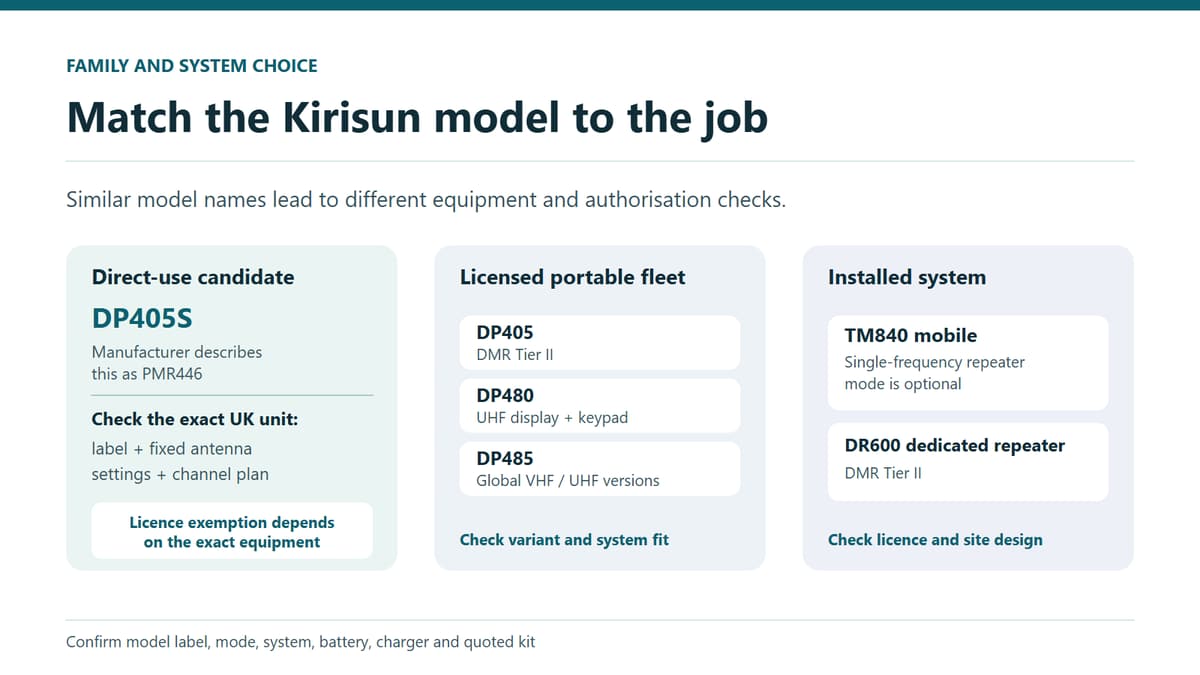
Kirisun DP405S, DP405, DP480 and DP485: Match the Radio to the Fleet
Kirisun's DP405S, DP405, DP480 and DP485 names are close enough to invite a wrong fleet choice. Begin with the exact model and regional label, then decide whether the job needs a PMR446-compliant direct-use set, a licensed DMR fleet, a vehicle mobile or a dedicated repeater. Pack size comes after those decisions. A twin, quad or six-pack title does not prove programming, battery, charger or accessory inclusion.
DP405S and DP405 are separate radio decisions
Kirisun's DP405S V1.0 brochure labels that family PMR446 and describes analogue/digital mixed receive behaviour. Its broad accessory and channel-spacing entries do not themselves establish that every delivered regional unit satisfies the UK's licence-exempt equipment conditions. Check the actual label, fixed antenna arrangement, approved settings and matching channel/code configuration before calling the offered set licence-free. The PMR446 guide covers the underlying UK equipment rules.
The separate DP405 manufacturer page identifies a DMR Tier II professional portable with VHF and UHF versions. Its higher-power licensed-family specification cannot be copied into a DP405S offer, nor can a DP405 be made licence-exempt merely by selecting a lower setting. Confirm the exact delivered band, licensed frequencies, digital/analogue mode and group programming with the responsible licensee. The UK licensing guide explains the authorisation choice.
DP480 and DP485 add different fleet questions
The DP480 manufacturer page shows a display and keypad, UHF 400–470 MHz specification, roaming in its stated IP-site system and optional GPS. The separate DP485 page describes a DMR Tier II portable with global VHF and UHF versions, and likewise labels GPS optional near the model introduction. Do not infer that a merchant UHF listing contains every global variant or enabled GPS, encryption or roaming service. Confirm the actual unit, software and site system before buying a fleet addition.
Analogue/digital mixed receive behaviour does not mean every radio with the same band will communicate with it. Match the authorised channel plan, DMR mode, colour code, groups, encryption configuration if used, and actual system architecture. The protocol compatibility guide explains the cross-brand limits; test the proposed Kirisun unit on the existing system before issue.
When do TM840 and DR600 belong in the system?
The TM840 is a mobile transceiver family requiring a suitable vehicle or fixed installation and power arrangement. Kirisun lists single-frequency digital repeater mode as optional: that is a model/configuration possibility, not proof that a purchased mobile provides the function or replaces a dedicated repeater. The vehicle mobile guide covers the separate installation and power checks. The DR600 current page identifies a dedicated DMR Tier II repeater with its own band, power, antenna, site and licensing requirements. An older DR600 brochure mentions a Tier III software upgrade; check current supported entitlement before treating Tier III as an included feature. The RF guide explains the antenna and feed checks for the proposed site design.
Match batteries, chargers and spare parts by exact revision
Kirisun's DP480 service parts table names KB-75A, but that alone does not establish every charger, region, supplied battery or cross-revision interchange. A DP405 service table names 7MHP-4141-04C-W0 as one volume-knob revision; it is a technician's part identity, not an instruction to repair a radio in service. For a quote, ask for the radio's full variant and serial/revision context, specified battery, single or multi-charger assembly, UK mains supply, antenna and programming service. The merchant KBC-500Q, KBC-480Q and six-way base codes need exact manufacturer fit and power evidence before any inclusion promise. The charger guide explains the component-chain check.
What should a fleet trial prove?
- Record each actual model, regional band, programmed mode and licence or PMR446 equipment basis. Keep DP405S distinct from DP405 and the separately named UP405S family.
- Run calls in the intended work area and, for licensed DMR units, through the real direct, repeater or roaming configuration rather than a brochure range figure.
- Try the chosen battery, charger, audio, antenna and carrying parts as a complete assembly. Confirm what is actually included in each pack-size offer.
- Hand over a channel/group plan, authorised settings, spares list and a controlled process for replacement units, faults and future programming.
Ask for an itemised tested configuration, not only a model name and quantity. A catalogue's global feature list does not settle the delivered UK fleet.