
Two-way radio antennas and connectors: match the full RF path
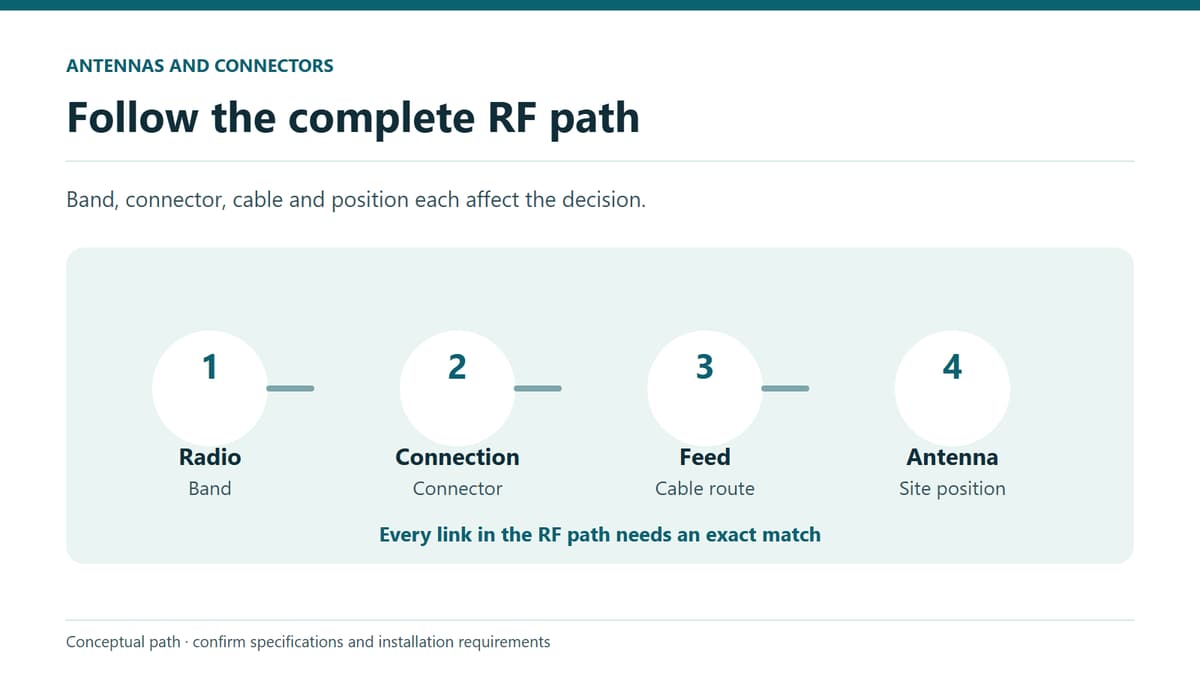
Match an antenna to the entire radio-frequency path: the exact radio band, antenna frequency range, connector, feed cable and installed position. A connector adapter can join two mechanical interfaces, but it cannot make a VHF antenna operate correctly at UHF or restore signal lost in a poor cable or location. For a licensed system, any change that affects radiated power or the approved installation must also be checked against its actual Ofcom authorisation. For a hazardous-area radio, only its exact approved antenna combination and site procedure govern; this general selection guide does not authorise a part change in a classified area.
Four checks before choosing an antenna
| Part of the path | What to verify | Why it matters |
|---|---|---|
| Radio | Exact model, variant, programmed transmit/receive band and antenna port in its current manual. | Two sets with a shared family name can have different VHF or UHF hardware ranges. |
| Antenna | Manufacturer part number, stated frequency range, connector, impedance and intended mounting arrangement. | An aerial can physically attach yet be outside the radio's operating band. A connector adapter does not change its frequency design. |
| Feed and connector | Correct mating interface, cable type/length, condition and any planned adapters, lightning/earthing components or weather protection. | Every feed component has its own fit and loss; the installer must account for them as a system. |
| Position and authorisation | Indoor or outdoor site, mounting height, direction, structural and electrical safety, plus licensed ERP and any site-specific parameters. | Gain and position reshape coverage and interference. An antenna change may alter compliance without changing the transmitter's indicated power. |
Icom UK's antenna guide asks users to compare the radio's model label with the antenna's VHF/UHF marking and connector. Its specific BNC adapter advice makes the same point: after fitting an adapter, the antenna still has to match the radio band and operating frequency. For a damaged socket, uncertain fit or an antenna that will not seat normally, stop and use the exact model's service route; do not force the connector or transmit to “test” a suspect assembly.
Understand gain without turning it into a range promise
Antenna gain compares radiation in a direction with a reference antenna. dBi uses a theoretical isotropic reference; dBd uses a half-wave dipole. The two numbers are different reference scales for the same antenna pattern: Ofcom's gain guidance, section 6.7, gives the conversion as dBi = dBd + 2.15 dB. Thus, a gain stated as 3 dBd is approximately 5.15 dBi on the other reference scale, allowing for rounding. These are two ways of stating one antenna gain, not gains to add together.
More nominal gain does not promise longer useful coverage at every point. Radiation pattern, antenna height, surrounding steel or terrain, mobile user location, cable loss and interference all matter. A site survey or controlled comparison should record where both ends can actually hear intelligible calls, using the licensed arrangement. Do not select a larger gain figure alone to solve a shadowed room or an indoor-to-outdoor path.
Account for cable, grounding and installation
For a remote or base antenna, ask the installer for the whole feed design: cable model and length, connectors, expected loss at the operating frequency, support, weather sealing, grounding and lightning arrangements. A longer or unsuitable feed can use up much of the benefit of a higher-gain antenna. Grounding is not a universal single-wire instruction: the correct approach depends on the actual antenna, mounting structure, vehicle or building and applicable safety requirements. Use the manufacturer's instructions and the installation design for the proposed equipment.
External mast and vehicle installations belong with qualified personnel and the exact manufacturer instructions. HSE warns that overhead power lines can cause fatal injury even without contact; installation near them requires a specific safe plan and competent advice. A vehicle installation also needs the vehicle and radio maker's mounting, cable and airbag requirements. No one should infer a safe drilling point, earth bond or lightning protection specification from a product title.
Check the licence before changing the RF path
Effective radiated power (ERP) accounts for transmitter power, feed loss and antenna gain, as Ofcom explains in its general ERP definition. It is not simply the wattage printed on the radio. Ofcom's Business Radio guidance asks for antenna gain, height and ERP in relevant applications and says technically assigned power is what the actual licence specifies. Have the licence holder or system designer check the authorised frequency, site, antenna and ERP before changing a fixed antenna, adding gain or moving a base station. A connector swap does not change that duty.
Licence-exempt PMR446 is different: Ofcom's Business Radio guidance states a 500 mW ERP limit and an integral antenna as technical conditions. It expressly warns that modifications such as adding an antenna connector must not take equipment outside those conditions. Do not treat an adapter or external antenna as a way to upgrade a PMR446 set while keeping its exemption. Our UK radio licensing guide covers the authorisation decision; for a coverage problem, the site and system should be assessed before buying an antenna.
What antenna will arrive with the radio?
Ask for the exact offered radio variant and the antenna part number listed on its quote or pack sheet. A manufacturer family page can list several VHF and UHF antennas under “standard accessories” because the appropriate one changes with the radio's band. Hytera's HP685 page, for example, names separate VHF and UHF antenna part numbers and frequency ranges; that list does not prove which one a particular retailer's box includes. A replacement antenna also has to match the exact band and connector, not merely the HP685 family name.
Send the supplier the radio label, current antenna part number, operating band, connector photographs, installation location and licence details where applicable. Ask for the antenna's frequency range and gain reference, the complete cable/mount/grounding parts, and confirmation of what the actual offer includes. Keep the exact approval and safe installation with the responsible licence holder and installer.