
Two-way radio specifications: what the numbers actually describe
A radio specification is useful only when you know which version, assembly and test condition the number describes. The same family may have VHF and UHF variants, several batteries and different keypad or feature options. Use the terms below to ask for exact evidence before comparing offers. A blank field does not establish the answer; it does not mean zero, unsupported or included.
Band and mode describe different things
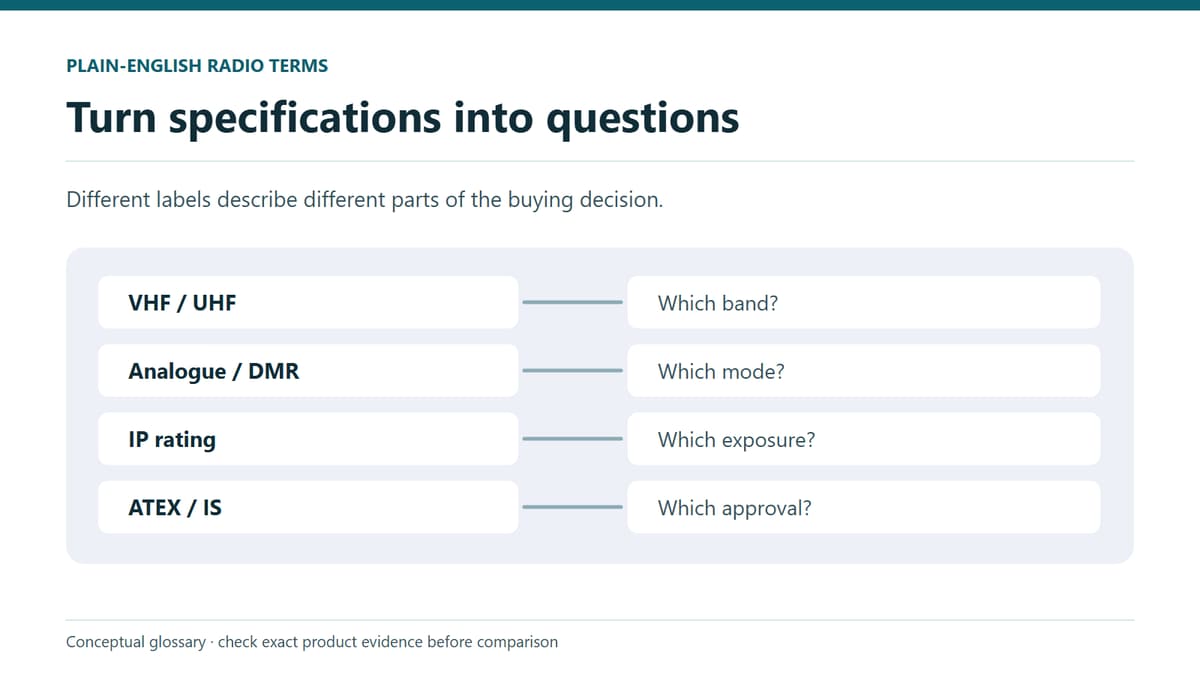
| Term | What it answers | What to verify |
|---|---|---|
| VHF or UHF | The radio's operating frequency range. | Exact hardware band and programmed frequency; the family name alone does not identify the supplied variant or antenna. |
| Analogue, DMR, dPMR, NXDN or TETRA | The transmission or system mode. | Matching mode, channel parameters and system access; equal band or channel number does not prove two radios can talk. |
| Channel capacity | How many channel records the device can store. | How many are programmed and authorised for this fleet; capacity is not the number of simultaneous conversations. |
| IP code | A tested enclosure protection classification against solids and water. | Exact radio-plus-accessory assembly, closure condition and maker's test claim; it does not establish hazardous-area approval. |
| ATEX / intrinsic safety | Hazardous-area equipment assessment and one possible protection method. | Complete Ex marking and approved radio, battery and accessory combination for the site's classification. The two labels are not interchangeable. |
The Hytera HP685 manufacturer page illustrates the variant problem: it lists both VHF and UHF ranges and four band-specific standard antenna options. That does not mean one handset operates on both bands or ships with all four antennas. Our protocol guide explains mode compatibility, and the ATEX guide covers complete certified assemblies.
Compare weight and dimensions on the same basis
Ask whether weight is the bare radio, radio with a named battery, or a working set with antenna and clip. Ask whether dimensions include the battery depth and antenna, and whether the number is product size or packed shipping size. A parcel weight is useful for delivery planning, but not for judging what a person will carry on a shift.
Motorola's EMEA R7 data sheet gives size and weight for named battery configurations. Its footnote says the listed radio weights exclude the antenna and General Option Board. A simple “R7 weight” copied without that footnote loses the comparison basis. By contrast, the Hytera HP685 web page prints one weight beside two battery options without explaining the included assembly in that field. Do not decide which battery that figure includes by guess; request the exact configuration or a model-specific source that states it.
Read battery life as a test profile
Runtime changes with battery part, analogue or digital mode, transmit power, location services, accessories, temperature and actual duty. A common 5/5/90 profile means five percent transmitting, five percent receiving and 90 percent standing by. It is a comparison condition, not a promise that every team will get the quoted hours.
Hytera lists different HP685 hours for its 2000 mAh and optional 3000 mAh batteries, with GNSS on or off, at high transmit power and a 5/5/90 duty cycle. The Motorola EMEA R7 sheet likewise ties typical battery life to 5/5/90 at maximum transmitter power and notes that GNSS, Bluetooth, Wi-Fi and option-board applications are disabled for those figures. Icom's IC-F29DR3 leaflet quotes about 26 hours only with the BP-280 battery, 5/5/90 duty and power save on. Compare the whole test sentence before comparing the headline hours. Our battery-care guide covers use and storage separately.
Read an IP claim as an exact enclosure claim
IEC 60529 is the standard for enclosure ingress-protection classification. An IP code does not prove that every headset, connector opening, battery combination or charging arrangement has the same protection. Ask which tested assembly and conditions the manufacturer states, and follow the manual after water exposure or damage. Do not read an IP rating as an Ex marking, a guarantee of underwater speech, or a permission to submerge a radio indefinitely.
Manufacturer pages can also need clarification. On the current HP685 page, Hytera's marketing sections say IP67 while its specification table says IP68 with a stated 2 m, 4 h condition. Those statements should not be merged into one unqualified merchant claim. Obtain the exact variant's current manual or declaration and the tested assembly before specifying water resistance. The existing IP-rating guide owns the detailed ingress question.
Separate standard, optional, programmed and licensed
A feature can be present in hardware but disabled, an optional accessory can appear on a family page, or software may require configuration, entitlement or a compatible network. Do not turn a brochure feature icon into a promise about the delivered set. The Motorola R7 EMEA sheet presents separate full-keypad, non-keypad and R7a columns and notes variant and subscription conditions. Hytera lists the HP685's 3000 mAh battery as optional. The exact quote, part numbers and configured system decide what is actually supplied and usable.
If a material specification is missing, ask for written confirmation before comparing offers. A blank field does not mean zero, that a feature is absent, or that an accessory is supplied. “Not applicable” means the feature does not apply to that product; “not included” describes a checked offer without that item. Ask the supplier to state the battery, antenna, clip, charger, audio parts, programming, licence and any software or service terms in writing. That makes two offers comparable as working systems rather than as isolated headline numbers.