
Two-way radio battery care: storage, damage and recycling
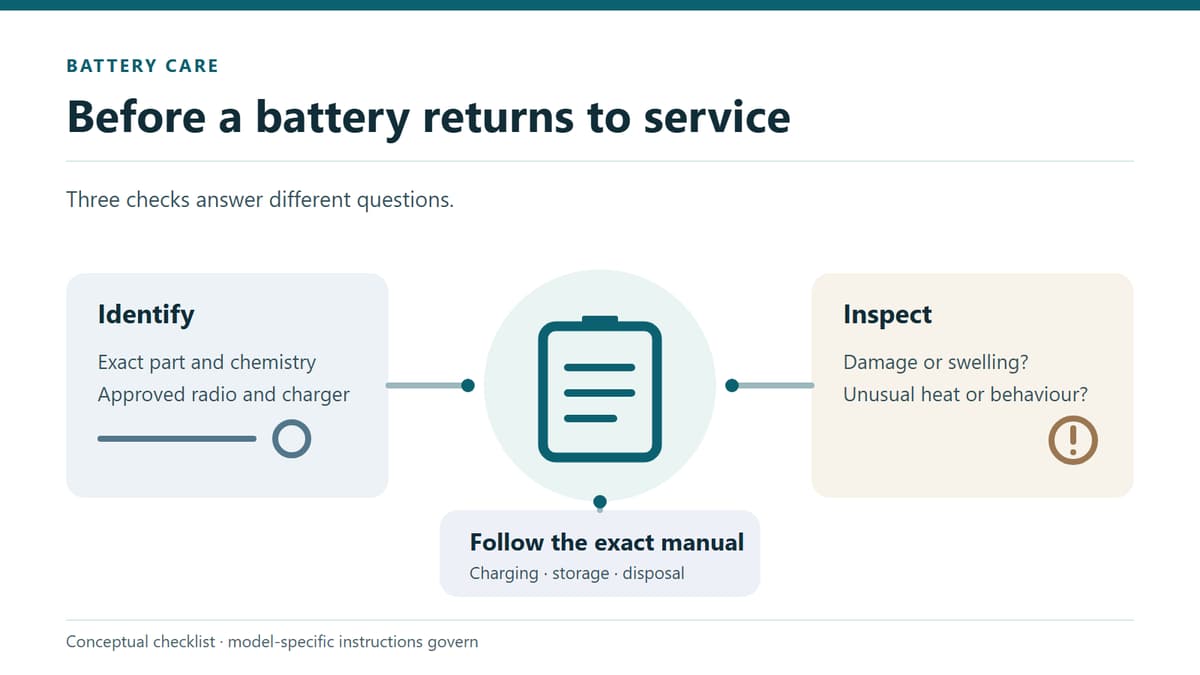
A radio battery's safe handling and storage instructions depend on its exact part number, chemistry and charger. Keep the battery and radio manuals with your fleet record, inspect packs before use, and retire a pack that is damaged or behaves abnormally. The storage charge level and recharge interval are not universal: follow the instructions for that battery family.
Daily use, storage and replacement
| Situation | Practical check | Decision |
|---|---|---|
| Before a shift | Check case, contacts and charge indication; confirm the battery is the approved part for the exact radio and charger. | Keep a charged spare if the real shift duty cycle needs one. Do not rely on a nominal runtime figure alone. |
| Long-term storage | Read the maker's instructions for storage charge, temperature, battery removal and recharge interval. | Label and review stored stock; avoid leaving a pack fully depleted for a prolonged period. |
| Damage or abnormal behaviour | Look for swelling, leaks, heat, case damage or repeated charger faults. | Stop using or charging the suspect pack and follow the maker's isolation, service and disposal instructions. |
| End of life | Identify whether the pack is a portable or industrial waste battery and the applicable collection route. | Keep it out of ordinary rubbish and use an appropriate battery collection or producer take-back channel. |
Why a single storage percentage is misleading
Hytera's current support guidance says to use the battery manual's recommended storage charge, remove the pack from the radio if appropriate and recharge periodically as that manual directs. Motorola's published battery-care sheet gives more specific instructions for the battery groups it covers, including different handling for new sleep-mode packs and active-circuitry packs. Those instructions should not be transferred to another battery by brand name alone. Record the exact part number and document edition before setting a fleet-wide storage schedule.
Charging and damaged packs
Use the approved charger and supply for the exact battery. If the charger reports a fault, check its own LED table and the manual's troubleshooting steps; do not repeatedly force a damaged pack through a charge cycle. Keep batteries away from metal objects that could bridge exposed contacts. Do not crush, puncture, open or heat a pack. If it is swollen, leaking, hot or physically damaged, stop using and charging it and follow your organisation's battery incident procedure. If a battery is smoking or on fire, leave the area, stay out and call 999; do not try to extinguish it. This emergency advice follows Scottish Fire and Rescue Service guidance.
For intrinsically safe radios, the approved battery is part of the certified combination. Check the exact radio, battery and approved accessories before replacing a pack; do not infer that a physically fitting battery preserves hazardous-area approval.
Recycling a radio battery in the UK
Waste batteries should not go into ordinary household rubbish. UK collection routes differ for portable and industrial batteries. A small or hand-carried radio pack is not automatically classed as portable: a battery designed exclusively for industrial or professional use can be classified as industrial. Use by a business alone does not determine the class. A shop's portable-battery collection point is not automatically the right route for a pack classified as industrial. Check the maker's disposal information and ask the supplier or producer to confirm the classification and accepted route when unclear. Protect exposed lithium-battery terminals as the collection instructions require, and seek specialist handling for a damaged or overheating pack rather than placing it in an ordinary collection box.
For choosing the complete charging arrangement, see our radio charger compatibility guide. For shift planning, read the battery runtime guide. Browse radio batteries only as candidates until exact part-number fit is confirmed. For detailed care and disposal rules, use the Motorola battery-care sheet, Hytera support guidance and UK waste-battery guidance.