
Maximising Two-Way Radio Battery Life for 24/7 Shift Work
For continuous shifts, plan a rotation of identified radios, batteries and chargers. Record when a pack is issued, changed and returned to charge. Keep a checked spare at the handover point based on the team's real call pattern; a manufacturer's test figure does not promise a whole shift in every building or temperature.
Use one traceable handover routine
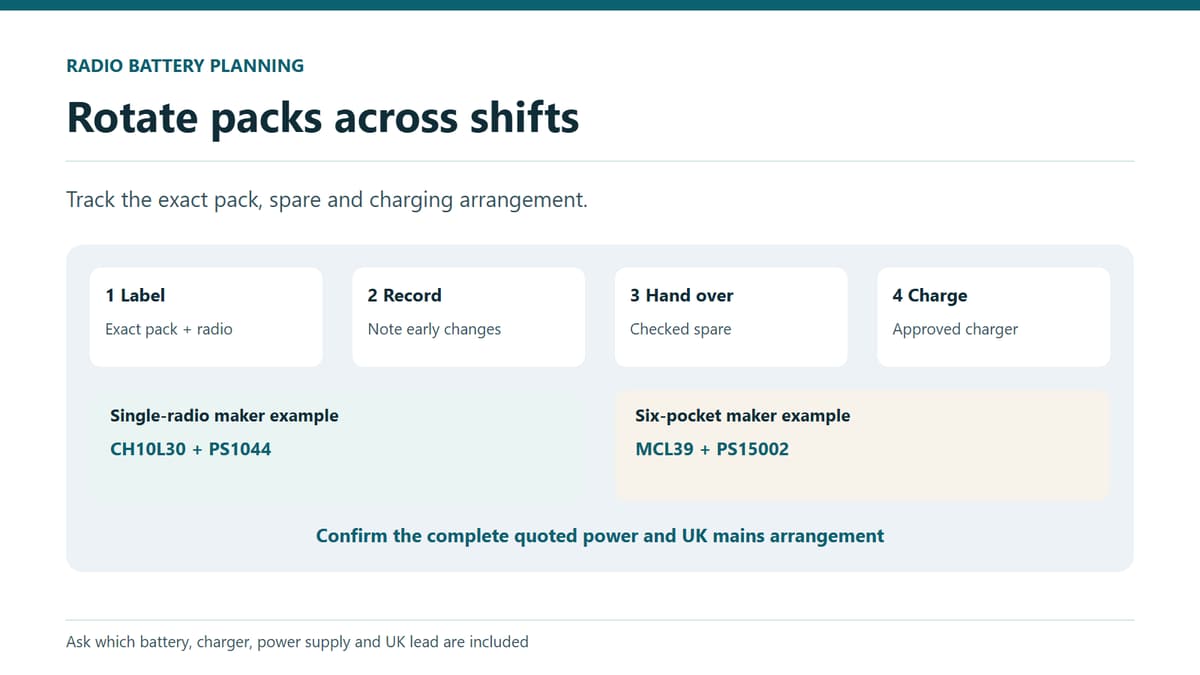
- Label the pack: record its part number, assigned radio family and condition. Start with the manufacturer's approved radio, battery and charger combination.
- Record an early change: note the radio, pack, location and work pattern. Repeated calls in a weak area, heavy transmission, cold conditions, an ageing pack or a charger fault can each matter.
- Hand over a checked spare: confirm its charge indication, correct part, contacts and physical condition before the next worker relies on it.
- Use the approved charger: keep the documented cradle and power supply together. Follow the exact maker instructions for charging location, indicator meanings and safe handling.
Stop using a swollen, leaking, unusually hot or damaged pack. The battery care guide covers storage, incident and recycling decisions; the charger guide covers the complete battery, cradle, supply and plug chain.
Read HP605 and HP685 figures as test conditions
Hytera's current EU HP605 and HP685 pages list a 2,000 mAh battery and an optional 3,000 mAh smart battery. Their published battery-life rows use a 5/5/90 duty cycle at high transmit power, with separate GNSS-on and GNSS-off figures. That test pattern means five per cent transmitting, five per cent receiving and ninety per cent standby. Actual shifts can differ. Use the specific labelled battery and a trial of the proposed setup before changing the fleet's spare ratio; capacity alone does not prove an individual used pack's condition or a whole-day runtime.
Build the charging station from named parts
For the named HP6 models, Hytera lists the CH10L30 single desktop cradle with a 12 V DC, 1 A input. Its PS1044 power-adapter example has a 12 V DC, 1 A output and manufacturer-listed British and European plug types. For several positions, the MCL39 manufacturer page lists six pockets, PS15002 and the BRK20 wall-mount option. These are manufacturer compatibility examples, not proof of the mains lead, bracket, battery or other items included in a SyncComms offer. Ask for the actual UK-ready quoted combination and the number of radio or spare-battery positions needed at shift change.
If packs repeatedly change early, compare the records with real transmit use, locations, battery age and charger results. Resolve the cause with the exact model instructions before buying higher-capacity batteries. The Hytera selection page covers the broader model choice.