
Two-way radios for warehouses, retail and logistics: follow the work
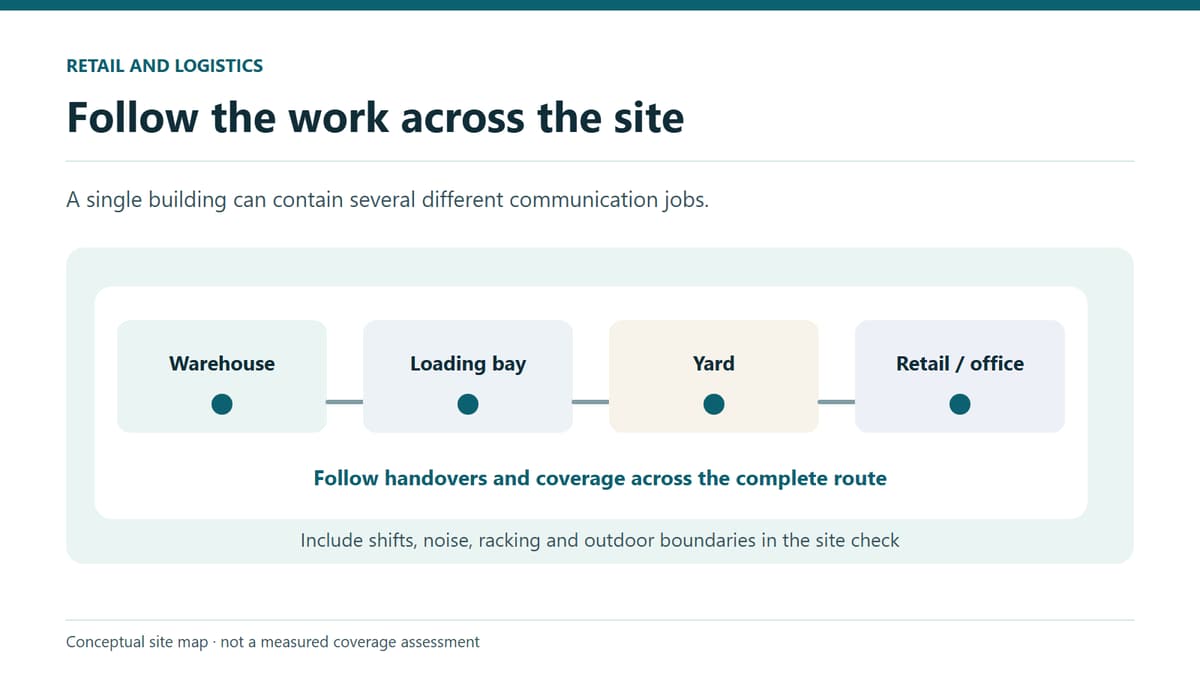
Choose radios for the route a job follows: a worker may move from a warehouse aisle to a loading bay, out to a yard and into a retail or office area. Each handover can introduce a coverage gap, a different noise level or a different team. Map who must speak to whom at each point, then test the proposed system at those points during real working conditions. A single advertised range figure cannot establish coverage through racking, doors, vehicles and multiple floors.
Map the work before choosing the network
| Place or handover | Call that must work | What to check on site |
|---|---|---|
| Warehouse aisles and mezzanines | Picker to supervisor, maintenance or first responder. | Racking changes, stock levels, lifts, plant rooms, stairwells and the worker's normal carrying position. |
| Loading bay and yard | Dock team to dispatcher or visiting driver. | Vehicle movement, closed shutters, weather, traffic separation and who controls a handover. |
| Shop floor and back office | Customer-facing staff to stockroom, security or duty manager. | Discreet audio, background music, separate group calls and the route between front and back areas. |
| Road vehicle or remote site | Driver or branch to local site and central operations. | Whether a fixed mobile radio, licensed repeater network or cellular service actually provides the needed path. |
Write down both ends of each required call, the call type, the expected reply and what the team does if the first path fails. Test with doors and shutters in their normal positions, around occupied racking, and when the site is noisy or busy. HSE's warehousing guidance stresses clear responsibility for visiting drivers and effective agreed signals where verbal communication is not possible. Radios help coordinate work; they do not replace pedestrian/vehicle separation, site rules or an agreed signal procedure.
Single site or several sites?
A local handheld group may be enough for one small, measured site. Larger buildings can need engineered antennas or repeaters; a campus, separate warehouses and road vehicles may need a more deliberate network or dispatch arrangement. Keep the technology decision tied to the required call path and the actual licence. A mobile transceiver in a vehicle needs power, antenna, mounting, controls and a safe-use policy as a whole system.
One real example shows why testing and site structure matter. In Hytera's published Wincanton case study, a partner first trialled a DMR repeater system at one retail distribution site, then deployed separate systems at further sites with additional repeaters for blackspots. Wincanton used different keypad and non-keypad handsets according to roles. That is a reported 2020 deployment, not a measured result or kit recommendation for another warehouse. Our mobile-radio system guide covers vehicle and desk dependencies.
Keep radio groups useful during a shift
Give each role a short list of calls it needs. Pickers may need a local operations group, while a duty manager may need a cross-team escalation path. Do not put every routine stock query on a shared urgent channel. Confirm how a user switches groups, who can call everyone, and how a message reaches a worker in a yard or another building. The programmed talk groups, individual calls and any repeater or gateway must be tested together; a list of radio features does not prove an end-to-end workflow.
For safety-critical calls, state who receives them, who acknowledges, how the team escalates and what happens if the radio or network is unavailable. Do not treat a lone-worker or emergency button as a monitored service merely because the handset has one. A separate site emergency procedure remains essential. For routine messages, avoid personal or sensitive customer data on an open channel; our privacy and encryption guide explains why a tone code is not confidentiality.
Choose audio that preserves awareness
Noise at a dock or near machinery can make speech hard to hear, but an earpiece is not automatically suitable hearing protection. HSE's noise guidance, paragraph 250, says hearing protectors must be selected so necessary speech and warning signals remain clear; an in-situ listening test can be useful. The site noise assessment, hearing protection, alarms and radio audio should be considered together by the responsible employer. Do not cover or remove required hearing protection to use a radio.
Check the exact radio accessory port, PTT location and microphone arrangement with gloves, helmets, high-visibility clothing and shared-user hygiene in mind. A boom microphone or remote speaker can improve practical use in one task, but test whether users can still notice vehicles, alarms and colleagues. Our audio and carrying guide covers connector and accessory fit.
Handover, cleaning and charging between shifts
Decide where each radio is numbered, issued, returned, charged and reported faulty. Record a charged-spare policy against actual shift length and use, and label batteries and chargers by their approved family. Do not infer that an eight-hour shift requires a particular advertised runtime: the maker's duty-cycle test may not match your users' traffic, cold yard work or enabled features.
For shared equipment, use the exact maker's care procedure rather than a universal disinfectant. Motorola's R7 manual gives model-specific cleaning and disinfectant advice, while another radio may forbid the same chemical or require different seal care. Assign users their own suitable audio hygiene parts where possible and check the accessory's separate instructions. Remove damaged or suspect batteries from ordinary issue and follow their exact safety and disposal route.
What evidence makes the decision credible?
Ask a supplier for a marked site map, exact test route and failure points; the number and roles of users; proposed radio variants, antenna/repeater and licence; audio and battery assemblies; and the call-group and escalation plan. A useful pilot records who made each call, from where, to whom, with what antenna and battery, in both quiet and normal operating conditions. It should also record missed calls and failed handovers, not just successful demonstrations. After any racking, building or fleet change, repeat the affected checks before claiming the original result still holds.