
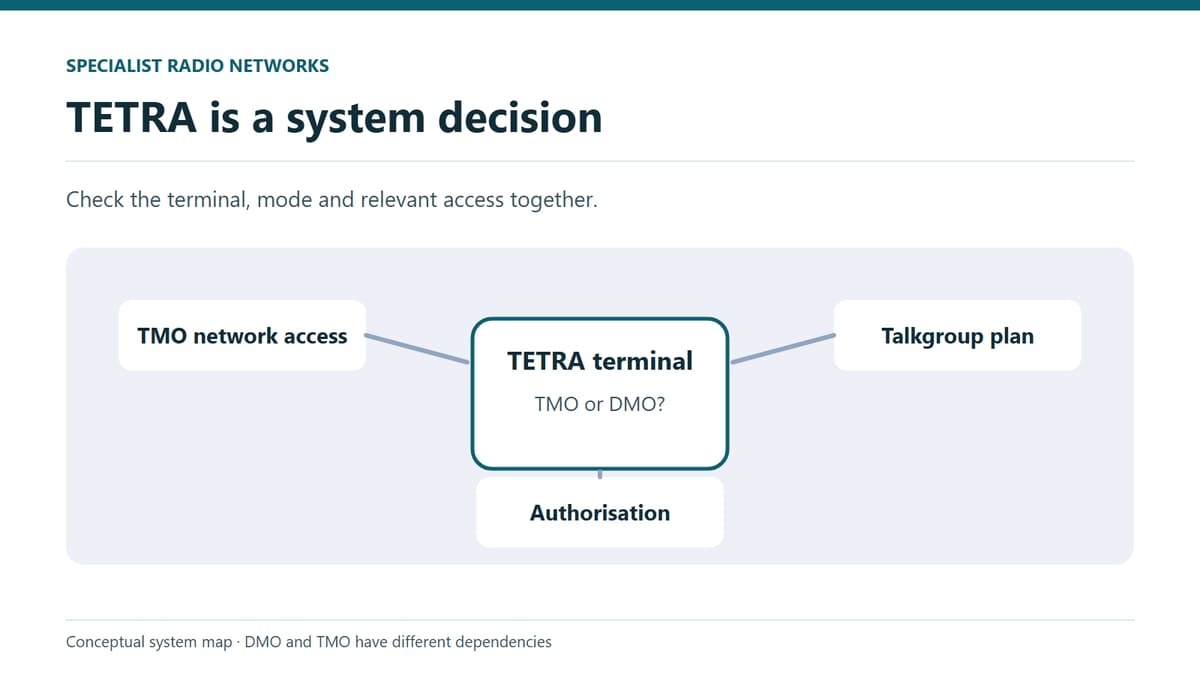
TETRA radios: check the network before the handset
A TETRA handset is part of a radio system decision. Before buying a terminal, establish whether the job needs calls through a particular TETRA network, direct radio-to-radio calls, or both. For network calls, coverage, operator approval, the exact band and terminal configuration are separate prerequisites. Owning a TETRA radio does not grant access to someone else's network.
Network mode and direct mode do different jobs
| Mode | What the user gets | What must be checked |
|---|---|---|
| TMO: trunked-mode operation | Group and individual calls use TETRA infrastructure that assigns radio resources and serves the network's users. | Network operator acceptance, authorised spectrum, matching terminal band, subscriber identity, talkgroup permissions, coverage and required security configuration. |
| DMO: direct-mode operation | Suitable terminals can communicate directly without network infrastructure, subject to range and matching DMO settings. | Both radios' DMO support, authorised channels, group settings, any required security keys and the site's operating procedure. DMO provides local calls outside network coverage, but it does not reproduce every TMO service or automatically connect to the network. |
| Gateway or repeater | An approved equipped terminal or system can extend a defined DMO path or bridge DMO and TMO. | The exact gateway feature, equipment, network policy, channel/group mapping and acceptance test. Do not assume every vehicle radio or handset supports it. |
ETSI describes TETRA direct mode as communication without network infrastructure. Motorola's MXM600 brochure illustrates one particular vehicle gateway between DMO users and a TMO network; that example is not an approval for another model or network.
Confirm access before selecting a terminal
Ask the network owner or operator for its approved terminal list, frequency band and regional variant, registration/provisioning process, talkgroup plan and coverage expectations. Check who can authorise a new subscriber and manage lost or retired units. If the fleet requires encryption, ask which exact security class, feature entitlement, key-management process and policy apply. The ETSI TETRA security specification includes authentication and optional air-interface encryption, but the word “TETRA” on a box does not prove that encryption is active or that an unfamiliar handset has compatible keys. Keep those details within the organisation's approved secure process.
For a self-provided UK business-radio system, confirm the exact authorised band, channel arrangement and licence conditions with the responsible licence holder. A terminal's advertised frequency range does not establish permission to transmit. A TMO network operated by someone else also has access rules and approved equipment lists. Use our UK radio licensing guide for the broader licence decision.
Vehicle and control-room equipment is a complete installation
For a vehicle, record the approved transceiver and control-head variant, power supply and wiring, TETRA antenna and its location, external audio/PTT, mounting position, data interface and any DMO gateway requirement. Confirm that an authorised installer can follow the exact installation guide and that the operator will accept the finished configuration. The Motorola MXM600 data sheet, for example, shows different control-head configurations and separate power, TETRA antenna, GNSS and accessory connections; it does not establish what a merchant kit includes or what another TETRA network permits.
Questions to resolve before a quote
- Who owns the intended TMO network or licensed DMO system, and who approves a new subscriber when network access is required?
- Which exact terminal models, bands, firmware and feature options are supported for that operating mode?
- Are users expected to work in TMO, DMO or both, and which talkgroups and sites must be reached?
- What authentication, encryption and key-loading process is required, and who is authorised to carry it out?
- For a vehicle or base position, what installation, antenna, power, gateway, dispatch and emergency-call functions are needed?
- What acceptance test will confirm the intended TMO registration, group calls, emergency workflow, DMO behaviour and coverage where applicable?
For TMO, only the network operator can confirm access and feature behaviour. For DMO, confirm the authorised channel plan and exact group/terminal settings with the responsible licence holder and fleet administrator. If the intended mode or band is unknown, establish it before selecting a terminal and complete kit. For a separate comparison of analogue, DMR, dPMR and NXDN fleets, see our radio compatibility guide.