
3M PELTOR LiteCom, ProTac and FLX2: Choose the Complete Headset System
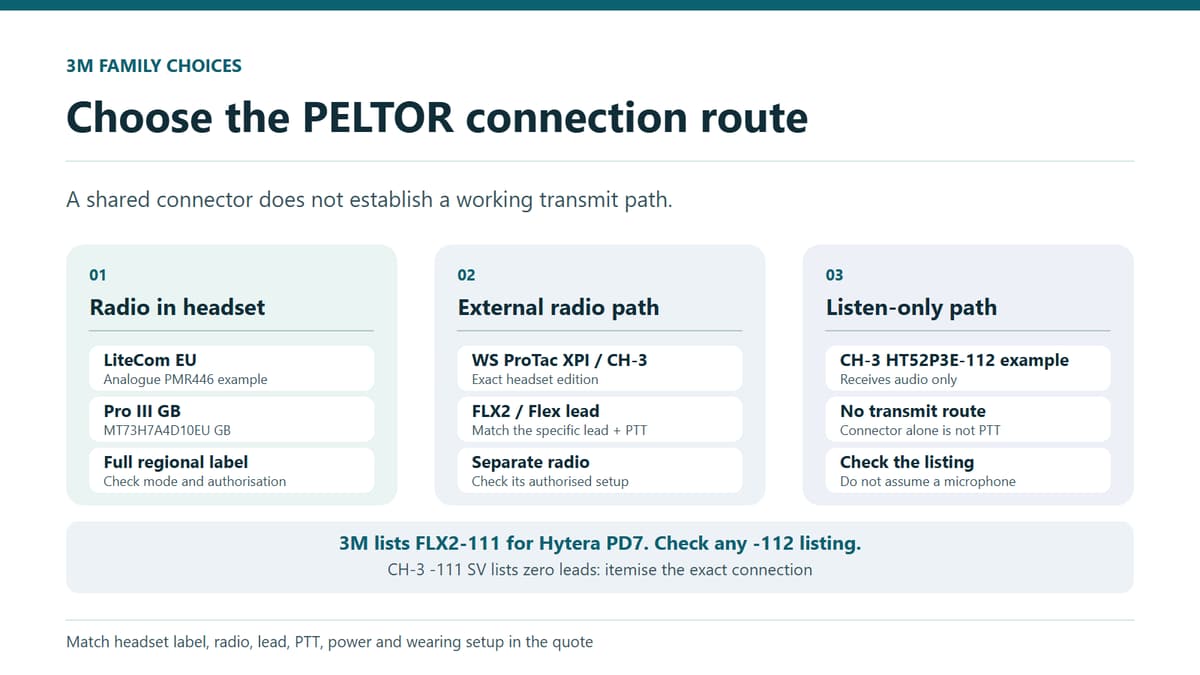
Some 3M PELTOR headsets include a two-way radio; others connect to a separate radio, phone or listening feed. Start with the complete communication path: headset model, built-in or external radio, cable or adapter, push-to-talk control, power and the way it will be worn. A shared brand name or an FLX2 socket does not prove that two parts will transmit together. The audio accessory guide explains the cross-brand connection checks; this guide separates the named 3M families.
Which headsets contain a two-way radio?
The current 3M UK LiteCom headband page identifies MT53H7A4400-EU as a hearing protector with a built-in analogue PMR446 radio. The 3M UK 2024 catalogue, printed page 89 also lists neckband MT53H7B4400-EU and helmet-mounted MT53H7P3E4400-EU versions. Choose the wearing arrangement and exact model before comparing a pack count. A twin, triple, quad or six-pack title does not itself establish every supplied battery, charger or accessory.
The WS LiteCom Pro III family is a different purchase decision. On the current 3M UK Pro III GB page, the full manufacturer product number MT73H7A4D10EU GB and 3M ID 7100153423 identify a PMR446-labelled analogue/digital headband edition. The manufacturer's separate August 2026 EMEA technical sheet, table 1 identifies unsuffixed MT73H7A4D10EU with SAP ID 7100098910 for 403–470 MHz. A seller title using only the shorter part string does not decide which regional edition is actually offered. Ask for the full label, 3M ID, programmed mode and the intended UK authorisation. The UK radio licensing guide covers the authorisation distinction; do not infer licence exemption from a headset name alone.
Which models depend on another radio or audio device?
WS ProTac XPI is a level-dependent Bluetooth headset family, not automatically a stand-alone two-way radio. The same 3M UK catalogue, printed page 88 distinguishes the headband, neckband and hard-hat versions and identifies the -111 variants as FLX2-equipped. Check the exact suffix and whether the intended external radio, Bluetooth device and control arrangement are supported. A Bluetooth link on a headset does not itself provide an authorised radio channel or a guaranteed talk path.
CH-3 is a wired communication-headset route. The 3M CH-3 MT74H52A-111 page identifies a headband with PTT adapter and FLX2 accessory connector. The separately listed MT74H52A-111 SV has a manufacturer lead quantity of zero. That is a practical reason to itemise the downlead rather than assume it is inside a headset box. A CH-3 HT52P3E-112 example is explicitly listen-only; hearing incoming audio does not establish a microphone or transmit/PTT route for a different listing.
The connector chain can have several parts: a headset connector, a particular FLX2 or Flex lead, perhaps an external PTT adapter, and the exact radio accessory port. 3M's FLX2 overview separates listen-only, PTT-adapter and direct-radio cable applications. The 2024 UK catalogue names FLX2-63-50 for a Motorola DP4000 Ex-labelled route, FLX2-21 for the listed Motorola GP300/DP1200 route, and FLX2-111 for Hytera PD7. Do not substitute a similarly numbered cable: a merchant listing for FLX2-112 cannot be treated as FLX2-111 or as proof of fit to every Hytera model. Confirm the actual label, pinout, PTT method and supported radio before ordering.
Power, hearing protection and hazardous areas
Power and replacement parts also belong to the exact model. The 3M FR09 page names a USB charging cable for the ACK053 battery route, while its WS LiteCom Pro III charging-cable page names ACK081. A battery code beside another family name is not proof of fit. Ask which battery, charging cable or supply, replacement microphone and hygiene kit are specified for the exact headset and what the quote includes.
The noise and hearing-protection guide explains why reducing exposure, microphone transmission, receive audio and protector fit need separate checks. Trial the chosen headset with the actual helmet, face protection, glasses and work posture; confirm the employer's hearing-protection assessment and the specific manufacturer's combination instructions. Do not assume a headset's advertised attenuation applies unchanged with every helmet, fitting or accessory.
An Ex mark on one cable or headset is not approval of the complete radio, battery, headset, lead, adapter and helmet arrangement for a classified area. The ATEX radio guide explains the site classification and complete approved-equipment check. The named older EX-suffixed parts in a quote need their own current certificate, matching approved combinations and service status; ordinary LiteCom or ProTac names are not hazardous-area approvals.
What should a useful quote and trial include?
- Record the complete 3M part number, 3M ID and regional radio edition for every built-in-radio headset. Distinguish individual headsets from merchant multi-packs and list supplied contents.
- For an external-radio route, name the exact headset, FLX2 or Flex lead, PTT adapter if needed, radio model/variant and a controlled receive-and-transmit test. State clearly if the arrangement is listen-only.
- Confirm the actual batteries, charger or power cable, spare pads, microphones and hygiene parts, and who supplies each item.
- Test speech, hearing, ambient awareness and wearing fit in the real noise and PPE arrangement. Confirm the site's radio authorisation and, where relevant, the complete approved Ex assembly.
Ask for the configuration and component list in writing before treating a generic “Peltor compatible” statement as a working fleet specification.