
Two-way radios for events, security and venues: plan the call route
Plan event radios around the venue map, people and decision routes before counting handsets. Stewards, production, security, first aid and the control point may need different routine conversations, while urgent information must reach the right decision maker quickly. A radio supports the event's documented procedures; it does not replace crowd management, public announcements, emergency-service contact or a protection plan.
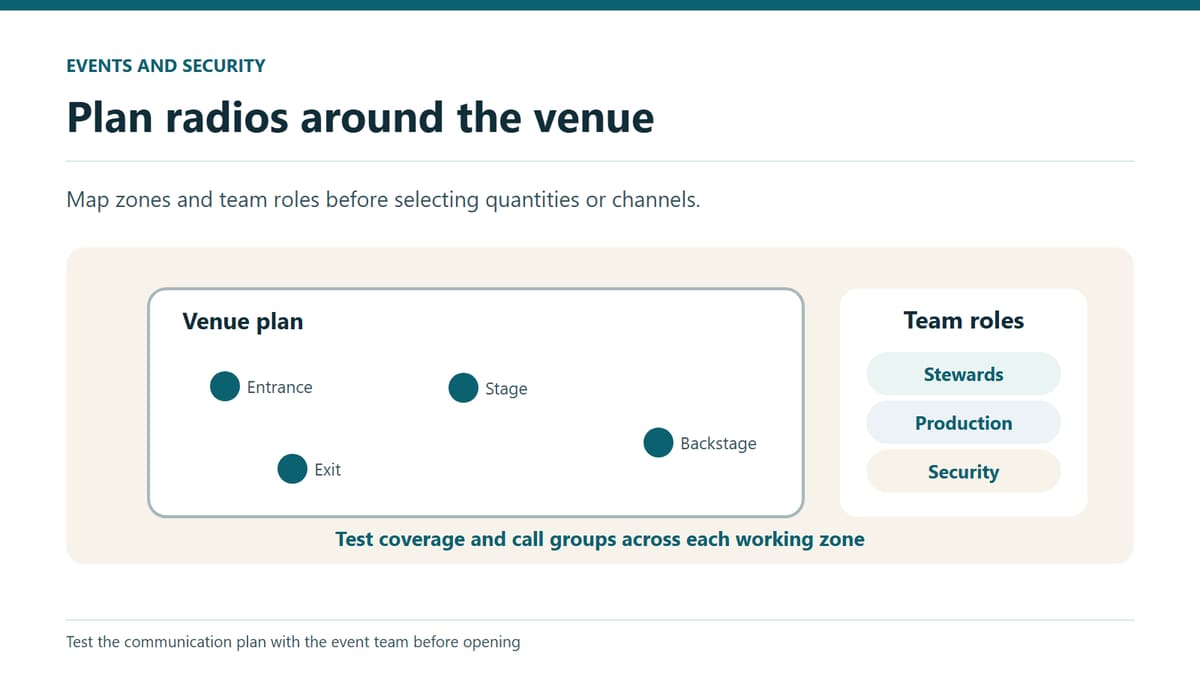
Map working zones and call groups
| Question | Practical planning record | Check before issue |
|---|---|---|
| Who speaks to whom? | List steward supervisors, entrances, production, security, first aid, traffic and central control. Mark which cross-team messages need a nominated relay or shared monitored group. | One person or post owns each urgent escalation; no assumption all users can hear every team. |
| Where must calls work? | Mark entrances, queues, stage, backstage, basement, stands, exits, car parks and any temporary build or moving route. | Test calls at the busiest and weakest likely locations, indoors and outdoors, with the intended accessories. |
| What happens when a channel or device fails? | Define an alternative call route, spare batteries/radios, charging and a way to reach the public announcement system. | Rehearse a controlled lost-radio, flat-battery and missed-call scenario. |
| Who can issue instructions? | Record command roles, escalation wording, confirmation and who can initiate a show stop or evacuation under the event plan. | Brief staff and volunteers; avoid treating a radio button as authority to act outside the plan. |
HSE event guidance calls for an effective flow of information between crowd-management staff during normal operation and emergencies. It describes a control point that gathers the venue picture and coordinates staff and external bodies, and recommends a backup if electrical communications fail. The event organiser's command structure and risk assessment decide the actual groups, not a standard channel list supplied with a radio.
Test coverage in the real event layout
A quiet, empty venue is a poor stand-in for a built and occupied one. Temporary steelwork, staging, screens, basements, crowds and vehicles can change the radio path. Mark a test route that includes the furthest entrance, queue, backstage position, control point, welfare post, exits and external perimeter. At each point record the radio, programmed group, accessory, whether both ends could hear intelligible speech, and the fallback used where a call fails. Repeat after material changes to the build or event plan. No stated “mile range” proves coverage through a particular arena or festival site.
Check the spectrum route for the actual equipment and purpose. Ofcom's Business Radio guidance says compliant PMR446 is licence-exempt but shared and unprotected from interference, so it does not provide a guaranteed exclusive event channel. Ofcom's PMSE guidance lists eligible event-management and production uses, with separate licence conditions and coordination; its examples for security and first aid exclude a Safety of Life purpose. Do not assume a PMSE event assignment authorises a Safety-of-Life radio service or that a past event's frequency is available again. Determine the right authorisation for the exact purpose, site, dates, users and system before programming or hiring. Our UK radio licensing guide covers the broader choice.
Keep emergency procedures larger than the radio system
HSE emergency-planning guidance says event plans should cover raising the alarm, summoning and liaising with emergency services, crowd management and clear roles. It calls for testing radios and public announcement equipment before the event. Give staff a short, practised call format: location, what has happened, immediate risk and who needs to respond. Require the receiver to confirm critical instructions according to the event procedure. Include a fallback if the control point, radio channel, public address or power supply is unavailable. A private event radio channel is not assumed to connect directly to police, fire or ambulance communications.
Security, stewarding and production teams can keep routine traffic separate while a named control role monitors urgent handovers. Decide who can move a message between groups and how to avoid losing it at a shift change. Brief temporary staff on their assigned channel, radio label, call signs, battery swap, lost-equipment reporting and the route for an emergency. Test any alarm or show-stop workflow only under the organiser's controlled exercise plan, so a rehearsal does not trigger a real response.
What Martyn's Law does and does not require now
As checked on 21 November 2026, the Home Office's overarching factsheet says the substantive requirements of the Terrorism (Protection of Premises) Act 2025, commonly called Martyn's Law, have not yet commenced. The SIA's November 2026 update expects commencement in spring 2027 and offers preparation tools. The Act's scope depends on the particular qualifying premises or event and its responsible person; a venue or event should use the current guidance to check its own position. A radio purchase is not a statutory compliance certificate, and the Home Office says the Act does not require buying equipment just to put standard-tier procedures in place.
The Home Office statutory guidance describes communication as one type of public protection procedure: informing, alerting and instructing people where safe to do so. Radios may help staff coordinate that work, but the responsible person must decide suitable procedures, roles, training, public messaging and other measures for the actual event. Existing health, safety, fire and licensing duties continue. Recheck official commencement and scope information when planning the event; a dated source check cannot settle a future event's legal duties.
Hire, power and handover across shifts
For hire or short-term deployment, ask for an itemised schedule of exact radio models and variants, programmed groups, licence responsibility, chargers and mains leads, spare batteries, earpieces, speaker microphones, carrying parts and the return plan. Test the supplied kit as a whole before doors open. Mark each radio and battery with an issue number, keep a charged reserve for each long shift and assign a supervised charging position away from public routes. The required reserve depends on the actual model, battery age, transmit duty, weather and shift length; an advertised runtime alone is not a staffing plan.
Record who receives each radio, who may reprogram it, what a replacement unit must contain and what happens if a supplier exchange changes the model or accessory connector. A later contractor's radio will not necessarily interoperate merely because it uses the same band or says “digital”. Test the whole fleet, including hires and control-point equipment, on the actual authorised groups before relying on it.
Keep sensitive details off an open call
Use the minimum information needed to direct a response. Avoid broadcasting names, medical details, incident allegations, access credentials or security-sensitive movements over an ordinary shared channel. Agree a controlled phrase or reference number and move details to an approved secure route when needed. A privacy tone or group name limits which radios normally open their speakers; it is not proof that outsiders cannot receive the signal. Assign radios to staff, use sensible talk discipline and handle lost units and recordings under the organiser's policy.
Bring the site plan, operating dates, team roles, number of simultaneous users, weakest coverage points, existing licences, shift pattern and emergency command structure to a supplier. Ask for the complete programmed system and a documented on-site test, including who will support faults during the event. The organiser retains the event plan and the decision about the right system.