
Marine VHF, DSC and AIS: choose the right radio and licence
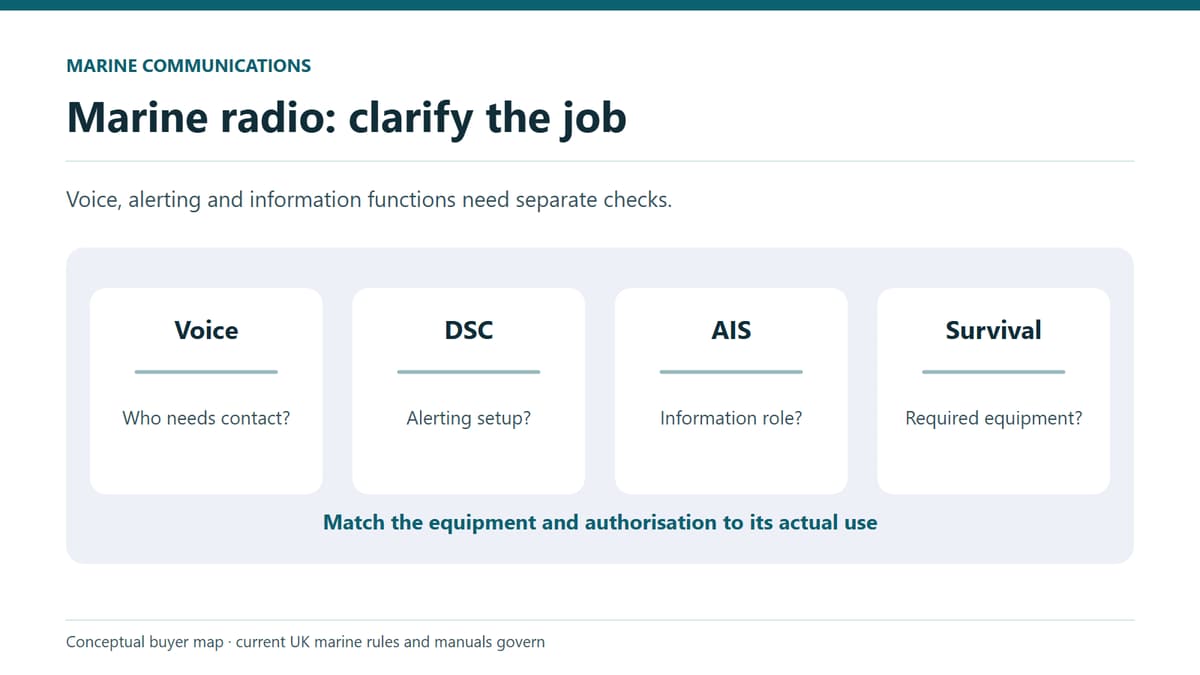
Choose a marine radio by the job it must do: ordinary VHF voice, DSC calling and distress alerting, AIS information, or the required equipment for a survival craft. These functions are not interchangeable. The vessel, operating area and applicable safety rules determine the radio, licence, operator certificate and batteries. A handheld's appearance alone does not answer any of those questions.
Ship radio or ship portable licence?
| Use | Licence and identity check |
|---|---|
| Equipment tied to a named ship | An Ofcom Ship Radio Licence covers equipment declared for that vessel. Ofcom's guidance permits a declared DSC handheld under this route for the named ship, subject to the actual licence and its terms. It is not an authority to use the set on another vessel. A handheld DSC transceiver needs its own assigned identity in the format specified by the current licence terms; do not copy the ship's MMSI into it. |
| Portable equipment used across vessels | An Ofcom Ship Portable Radio Licence can cover specified portable equipment used on different vessels within its territorial scope. The handheld DSC identity and its current licence record must match the particular equipment; do not substitute a vessel MMSI. |
| Use outside the portable licence's territorial scope | The Ship Portable terms cover the UK, Channel Islands and Isle of Man territorial seas only. Check the relevant vessel, flag and waters' rules before any use elsewhere; that portable licence alone does not establish overseas authority. |
Read Ofcom's ship radio guidance, Of168a alongside the current Ship Radio and Ship Portable licence terms. Schedule 3 of those terms specifies the handheld DSC identity format 2359nnnnn for a device used under either licence. The exact number must be the one assigned and recorded for that equipment. Check the current licence and any variation before programming; if a particular named-ship handheld identity is unclear, obtain Ofcom's current answer for that case before use. An MMSI sticker or old code on a used set is not evidence of the buyer's authorisation.
Operator qualification is separate from the equipment licence
For ordinary operation, the licence holder must authorise the user and ensure that person holds, or is under the direct personal supervision of someone who holds, the relevant Maritime Radio Operator's Certificate of Competence and a valid Authority to Operate. The current Ofcom terms make specific exceptions, including an emergency where there is a risk to life: any person may use the radio to summon assistance. Do not withhold a distress call because a bystander lacks a certificate. For a voluntarily fitted VHF/DSC radio on a UK pleasure vessel, the RYA's Short Range Certificate course and assessment covers the usual VHF/DSC operator qualification. Mandatory GMDSS vessels can require different certificates and procedures; the RYA certificate guide distinguishes SRC, LRC, ROC and GOC. Confirm the vessel category and actual licence conditions.
Voice, DSC and AIS answer different questions
| Function | Purpose and buying check |
|---|---|
| VHF voice | Spoken communication with vessels and coast or harbour stations on the appropriate marine channel. Check channel plan, antenna, waterproofing, power and the vessel's operational needs. |
| DSC | Digital Selective Calling can initiate routine, group and distress alerts with an identity and, when supplied, position information. Confirm the licensed MMSI and working position source for the exact set; if circumstances allow, a DSC distress alert is followed by a Mayday voice call under the MCA small-boat procedure. |
| AIS | Automatic Identification System provides identity and movement information to suitably equipped receivers. A receiver or AIS display is not a DSC distress-alerting radio. AIS information supports awareness; it should not be the sole basis for collision-avoidance decisions. |
HM Coastguard's GMDSS explanation describes DSC alert information; the MCA recommends automatic position input for equipment that sends it in a distress alert. Its AIS/VHF watchkeeping note explains the navigation context. Match an integrated “AIS/DSC” listing to the exact receive, transmit and alerting functions in its current manual; a feature name alone does not establish all three.
Survival-craft batteries are a separate requirement
For portable GMDSS VHF transceivers carried as mandatory survival-craft equipment, the MCA survey instructions, section 6.13 distinguish sealed, expiry-marked primary emergency batteries from rechargeable batteries used for ordinary onboard communication. Opening the emergency battery seal can make it unacceptable at survey. A routine rechargeable pack and charger are not automatically a substitute for the required emergency battery. This applies to the vessels and equipment covered by those survey instructions; it is not a universal rule for every leisure handheld. Check the vessel's actual carriage standard, radio approval, battery part number and expiry with its surveyor and the manufacturer's current manual.
Before buying or reprogramming a used DSC radio
- Identify the exact model, regional channel plan, approval and whether its DSC and position-input functions work.
- Read the set's current MMSI and identify whether it is a fixed ship DSC radio or an individual handheld DSC transceiver. Compare its identity with the actual licence and any variation. Do not transmit using an unverified previous owner's identity.
- For a fixed DSC radio transferred to a different ship, establish the receiving ship's assigned MMSI and the manufacturer-approved reprogramming route. For a handheld DSC set, establish its individually assigned handheld identity and licence treatment; do not apply the fixed-radio rule by analogy.
- Check the correct battery, charger, antenna and any survival-craft approval or expiry requirement for the actual vessel.
- Arrange a function check and operator training under the vessel's procedures before relying on the radio for safety use.
Ofcom's guidance, section 5.7 addresses a second-hand DSC radio being moved to another boat. The licence terms separately distinguish ship MMSIs from individual equipment identities and state that a Ship Portable MMSI remains with its radio equipment. Resolve an uncertain used handheld or named-ship identity with Ofcom before programming or use rather than applying a blanket reset rule.