
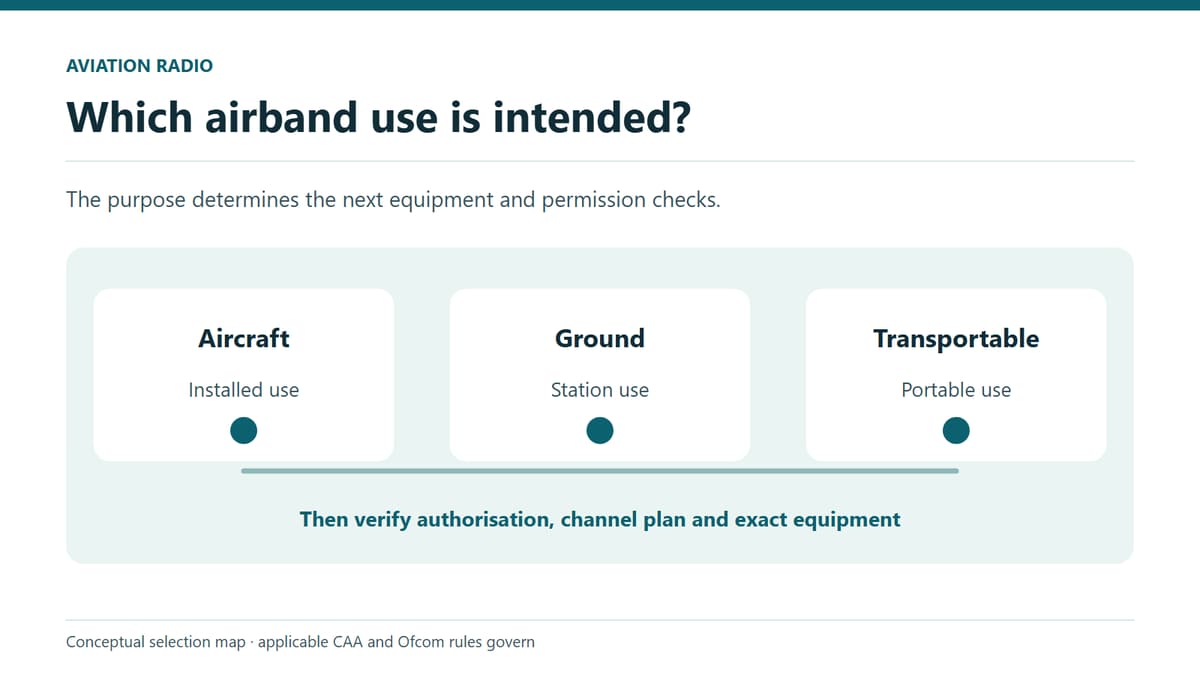
UK airband radios: aircraft, transportable and ground-station use
Decide the intended airband use before choosing a radio. An installed aircraft set, a hand-held set used as part of an aircraft station and a ground station have different authorisation and approval paths in the UK. Buying an 8.33 kHz-capable transceiver does not itself grant a frequency assignment, operator privilege or ground-station permission. Confirm the actual aircraft or ground service, equipment approval, station licence and trained operator before transmitting.
Which station is it?
| Intended use | Authorisation question | Equipment question |
|---|---|---|
| Installed aircraft radio | Which aircraft radio licence and flight radiotelephony operator privileges apply? | Is the fitted equipment approved for that aircraft and the required channels, antenna, headset and installation? |
| Transportable hand-held radio | Does the intended use fit Ofcom's Aircraft (transportable) licence for one portable VHF radio used as part of an aircraft station? | Is the exact portable set approved, with the appropriate battery, antenna and headset arrangements? |
| Aeronautical ground station | What ground-service type, assigned frequency, site licence and CAA assessment are required? | Does the station meet the current ground-equipment specification and installation conditions? |
Ofcom's aeronautical licence guide says an aircraft radio licence covers the aircraft and its carried radio equipment, while an Aircraft (transportable) licence covers one portable VHF set not tied to one aircraft. The CAA's Safety Sense guide describes the latter as a hand-held transmitter with its own antenna and power supply. Ofcom states that the transportable radio is not for use on the ground except as part of an aircraft station. Its ground-station products are separate and normally cover a site and assigned working frequency after CAA fitness assessment. Do not treat a portable aircraft licence as a way to operate an aerodrome or ground-support station.
Separate the station licence from operator qualification
Ofcom now issues and administers aeronautical radio station licences; the CAA confirms that new station-licence applications go to Ofcom. The CAA still handles its safety and frequency-assignment responsibilities. The CAA Flight Radiotelephony Operator's Licence (FRTOL) page explains the personal privilege for operating an Aircraft Radio Station in a UK-registered aircraft and the training, practical test and language-proficiency requirements. A station licence does not confer that personal privilege.
The CAA's July 2026 Safety Sense 22 radiotelephony guide notes narrow glider and student-pilot exceptions under stated conditions. It specifically says that glider pilots without an FRTOL may not use the radio to communicate with an Air Traffic Service Unit or Air/Ground Communication Service. Those exceptions should not be assumed for an ordinary business, aerodrome or flight operation. For a ground station, identify the actual service and the relevant operator qualification and procedures through the CAA and licensee; a pilot FRTOL alone is not a generic ground-station authority. Obtain approved training and the CAA's current FRTOL practical-test route where the aircraft privilege is needed.
Check channel spacing, approval and the actual set
The CAA describes UK aeronautical VHF voice service as AM in the 117.975–137.000 MHz allocation with 8.33 kHz channel spacing. Its Safety Sense guide explains that some radios require a specific 8.33 setting or channel-selection step. Use the current assigned channel and procedures for the intended service; a radio's ability to show a frequency is not permission to transmit there. Check CAA equipment approval for the exact installed or hand-held model and version. The CAA guide says many 8.33 kHz hand-held sets are covered by a general Light Aircraft Class 3 Equipment Approval, but that must be verified for the actual unit and use.
Manufacturer options can change what the buyer receives. Icom UK's IC-A25NE page describes different Sport and Pro packs: the Pro list includes a Li-ion battery, headset adapter and desktop charging parts, while the Sport list uses an AA battery case. That is Icom's named pack information, not proof of a particular Sync Comms offer. Its IC-A25NE/CE leaflet distinguishes NAV+COM and COM-only versions and lists model-specific power and headset options. Ask for the exact model suffix, regional version, approval evidence, included battery, antenna, charger, headset adapter and supported aircraft power arrangement before ordering.
Ground stations need a separate design
Aerodrome, recreational aviation, ground movement and fire services are not interchangeable labels. CAA guidance describes distinct ground-service purposes and operator responsibilities. Ofcom's licence page says ground equipment must meet the applicable performance specification and that most ground stations need 8.33 kHz capability. The proposed service, exact site, channel, antenna, power and operating procedure must be assessed and licensed together; no general retail handset recommendation settles those points.
Flying or operating outside the UK
A UK station licence, personal FRTOL or manufacturer approval does not automatically settle carriage, installation, channel use or operator privileges in another country. Check the destination state's aviation and spectrum authorities, the aircraft registration and the planned route before use. Do not programme or transmit on a channel solely because it appears in a UK guide, another country's chart or a radio memory.
For a useful quote, provide the aircraft registration or ground-service/site purpose, expected jurisdiction, exact channel requirement, installed-versus-portable use, existing antenna and headset interfaces, power supply and the operator's current credentials. Ask the supplier to identify the exact approved model and supplied pack. Have the responsible licensee, CAA/Ofcom route and qualified aircraft or station installer resolve the final authorisation and fit before the radio is used.