
Maximising Two-Way Radio Battery Life for 24/7 Shift Work
Plan batteries around the shift
Treat a 24-hour operation as a rotation of radios, batteries and chargers. Estimate duty pattern, transmit time, display use, scanning and temperature, then allow reserve capacity for handovers and unexpected work. Published duration depends on model and test conditions; it is not a promise of runtime for every shift.
A simple, traceable rotation
- Label each battery and assign a charged spare to the handover point.
- Start each shift with the radio, battery and charger specified for that model.
- Record packs that need an early change, become unusually warm or show physical damage.
- Charge used batteries in an approved charger in a clean, dry, ventilated location.
- Store spares under the maker’s stated conditions, away from heat, moisture and metal objects.
Do not return a damaged, swollen, leaking or overheated pack to service. Keep contacts clean and do not substitute a charger or battery simply because its connector fits. Follow the exact model instructions for storage, transport, inspection and disposal.
Use the record to find the cause
After a week, compare handover records with actual use. Repeated early changes can point to extra transmitting, poor coverage, cold conditions, an ageing pack or a charger problem. Resolve the cause against the exact model and battery rather than assuming a larger capacity is suitable.
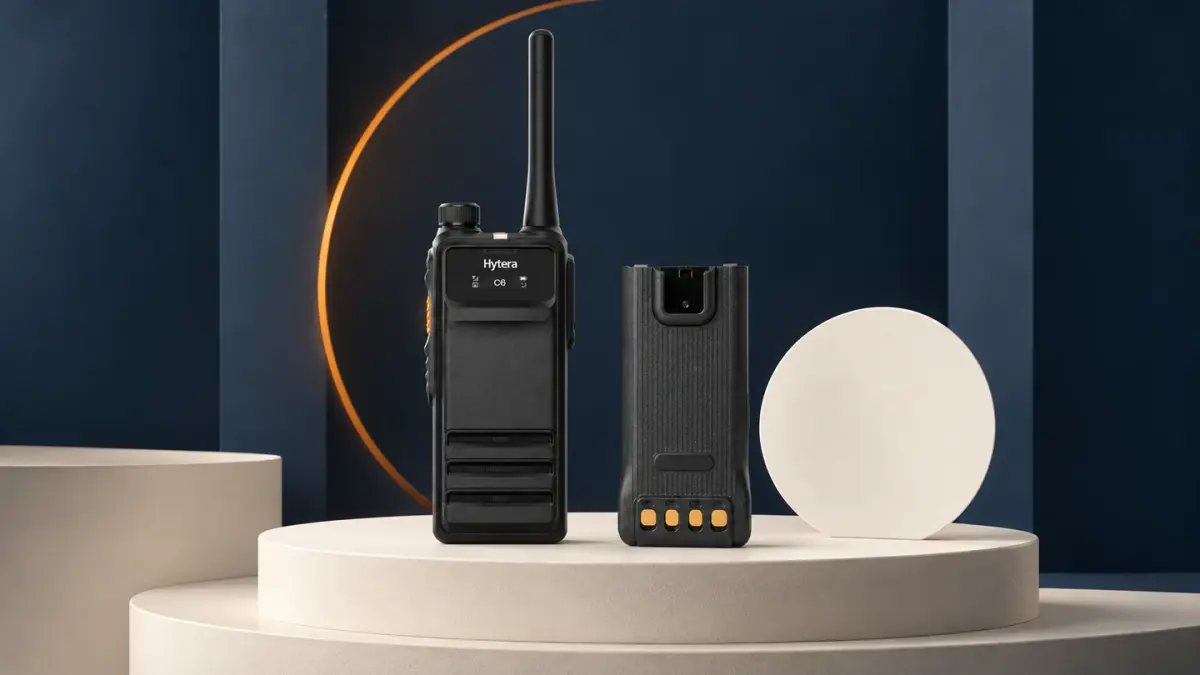
For HP605/HP685, compare the BP2002 2,000 mAh and BP3002 3,000 mAh batteries. For single-radio charging, the CH10L30 uses the separate PS1044 12 V DC, 1 A adapter; the UK/EU plug fittings are included with that adapter. For shared charging, the MCL39 uses PS15002 with a compatible UK mains lead; the optional BRK20 wall bracket is separate. Match the battery and charger arrangement to the exact quote.
Compare the relevant handsets and compatible setup choices in the Hytera radio selection guide.